Principalities and Powers of Sin and Death on Display

The principalities and powers of sin and death were clearly on ugly display before the world in yesterday’s Senate hearing. Will the exposure lead to repentance?

  • turning away from protecting the privileges of the privileged and toward solidarity with the vulnerable and violated;
  • away from the love of power and toward the power of love;
  • away from bombastic bullying and toward compassionate conversation;
  • away from tribal partisanship and toward justice for the common good.

It may be difficult to believe in the moment, but God has already won the decisive victory! Compassion, justice, and peace will win!

Let us live now in the light of God’s victory already won by engaging “the powers” at the ballot box, in our congregations and neighborhoods,  and in solidarity with and advocacy on behalf of the violated and vulnerable.


How We See Others Matters

Stanley Hauerwas, (here) my friend and colleague at Duke, writes this about Jean Vanier, founder of L’Arche, a community of persons with intellectual and developmental disabilities (here):

“. . . where I see an enemy to be defeated, he [Vanier] sees a wound that needs to be healed. That’s a big difference.”

Indeed, it is a big difference!

What if we were to consider ourselves and others as bearers of common wounds that need healing, rather than as adversaries to be defeated or competitors to be outdone?

What if we were to see the hurt beneath others’ anger, rather than as aggressors meriting our retaliation?

What if we were to view every person as a potential means of grace to us, rather than as an object of our correction or  charity or evangelization?

What if we were to approach those with whom we disagree as mutual explorers of the ineffable mystery we call GOD, rather than as misguided dupes in need of our superior insight?

What if we were to consider every person as a beloved child of God with infinite worth and dignity, rather than as an object of our desire or a means to our ends?

What if we were to see “the other” through the eyes of Christ, rather than through the lenses of partisan politics, racial prejudices,  and national borders?

The lens through which we view others really matters!

Who I Fear Most

We hear a lot about the role of fear amid current cultural, political, and religious wars. Pundits theorize that we tend to vote our fears, hoping someone will defend us against all threats and make us safe and secure.

“Fear of the other” dominates–those of different race, ethnicity, socio-economic class, sexual orientation, political ideology, religion, nationality. . . .!

quote-the-enemy-is-fear-we-think-it-is-hate-but-it-is-fear-mahatma-gandhi-52-28-02

I have an uneasy feeling that the person I fear the most is not “the other!”

The person I fear the most is myself! 

Maybe what I am most afraid of in the other is projection of my own woundedness, my own inadequacies, my own insecurities, my own prejudices,  my own  sinfulness.

Stanley Hauerwas put it pointedly:

“The fear that dominates our lives is not in the first instance the fear of an enemy, unless it is acknowledged that each of us is the enemy, but rather the fear that is the source of violence is the fear that makes us unwilling to acknowledge the wounded character of our lives.”

Overcoming my fear of the other requires that I honestly, humbly, and courageously confront my own woundedness. Projecting fear onto others only compounds its destructiveness.

God, grant me the courage to face the fear of myself in the light of Your Grace; and  may Your Love heal my wounds and cast out my fear! Amen.

“Anyone Who Comes to the Table Becomes Family”

Linda has a marvelous team of caregivers! With the exception of one substitute, they are members of the same family–grandmother,  two daughters, and a granddaughter. They lovingly, efficiently, and faithfully care for Linda around the clock, seven days each week.

I marvel at their skill, patience, and attentiveness. They can change the bed with Linda in it! Linda’s resistance and agitation never rattles them. Her slightest sounds and movements get their attention.

They treat Linda with utmost respect and dignity.  They have learned her unique mannerisms and sounds. She’s treated as a person with a story rather than as patient with symptoms. It is not uncommon for me to overhear one of them say, “I love you, Miss Linda.”

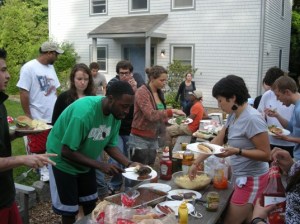
To them, “family” means more than biological relatives. That’s evident in their annual cookout.   Each year they have a huge cookout and invite all who wish to come.
cookout_pep


The event began a few years ago as a way of expressing appreciation to their neighbors who had helped them during a difficult time.  It has evolved into a joyful celebration of and for community.

Here is some of the food prepared this year: 16 racks of barbequed ribs, a roasted pig, 4 cases of chicken, two cases of turkey wings, several boxes of hot dogs, 10 gallons of baked beans,  10 gallons of green beans, 10 coconut pies, 10 sweet potato pies, 10 pecan pies, 2 sheet cakes that would feed a hundred people, dozens of cupcakes, scores of deviled eggs, and more! What a feast!

As many as 150 people show up! Black, brown, and white! Rowdy kids and frail elderly! Married and single! Gay and straight! Religious and non-religious! Educated and uneducated! Employed and unemployed! Parolees and police officers! Strangers and familiar neighbors! A motley gathering of diverse humanity!

“Anyone who comes to the table becomes family,” said the host. “It don’t matter who they are; they’re welcome!”

Now, as we pastors say, “That’ll preach!”

Caring for one another and all of God’s children seems to be in the DNA of this family! I know little about their religious affiliation and their understanding of religious doctrines.

What I do know is this: They embody Christlike love and their lavish table and generous hospitality are visible signs and foretastes of the kingdom of God.

Is this not what the church is called to be? Have we not been made one family? Is that not what we celebrate at The Lord’s Table?

God grant that the church would open wide its doors and announce to the world: “Anyone who comes to the Table becomes family!”



Prayer for Those Who Have Too Much

praying-hands_1027_1024x768

Abundant and generous God: your goodness is beyond measure; your power knows no limits except that which you impose; your bounty includes all that exists; your truth exceeds our comprehension; and your beauty is inexhaustible. We stand in awe before your inexhaustible greatness.

We acknowledge your provision for us and your preferential presence with those to have too little–the poor, the oppressed, the powerless, the vulnerable, the sick.

We pray today for those who seem to have too much, and thereby suffer from spiritual, moral, and ethical poverty:

  • those with so much wealth that they are blind to the plight of the poor
  • those with so much power that they exploit the powerless
  • those with so much health that they think they are invincible
  • those with so much intelligence that they lack wisdom
  • those with so much prestige that they lack humility
  • those with so much religion that they fail to be good
  • those with so much hate that they no longer love

Forgive us, merciful God, for assuming we are god and failing to live as though life is a gracious gift. You call us to be faithful stewards of your gifts and to welcome ALL to your table of abundance.

Grant us the mind that was in Christ Jesus–the humble mind, devoted to loving, seeking, and serving those who have too little. Remind us again that without self-giving love, we have nothing. Amen.


Let’s Remove Stigma from Dementia

 ” Dealing with early stage Alzheimer’s, I’ve found the hardest part is the stigma that comes with it. Friends don’t come around as often. Is this true?????,” wrote a friend.

care-97984_1280“Don’t tell anybody! I don’t want anyone to know,” pleaded Linda when in 2009 we received word that she has Frontotemperal Dementia (FTD).
“They’ll treat me differently. They will think I’m crazy,” she added.

Studies indicate that people fear dementia more than they fear cancer, and even death itself.

When asked what they fear the most, the answers vary: loss of control, loss of identity, “being a burden,” not remembering family, being treated differently, what other people will think.

A societal problem undergirds those fears, and it’s the stigma associated with the disease. Our hyper-cognitive, capacity-reliant  society diminishes the personhood and worth of people with cognitive impairments.

Even the word “dementia” contributes to the stigma. It literally means “loss of mind” and the dictionary lists the following among the synonyms: ”madness,” “insanity,” “derangement,” ”lunacy.”

Dementia is an umbrella term that covers multiple diseases that affect cognitive functioning, with Alzheimer’s disease comprising between sixty to eighty percent. Indeed, changes in the brain contribute to the diseases.

But dementia is more than a brain disease. Dementia is a social-relational disease; and the stigma society attributes to people with cognitive impairment contributes to its destructive consequences.

Stigmatizing people with Alzheimer’s and other forms of dementia may be more damaging than the pathology at work in the brain. Stigma contributes to isolation and diminished sense of self-worth.

There should be no more stigma associated with Alzheimer’s and other forms of dementia than with heart disease, diabetes, or any other disease. As with other diseases, those causing cognitive impairment are no respecter of persons’ class, education, race, prestige, or reputation.

All of us can contribute immeasurably to diminishing the suffering of those with Alzheimer’s and other forms of dementia. We can help remove the stigma!

Whatever our infirmities or frailties, we are ALL beloved children of God with inherent worth and dignity, and worthy of respect, relationships, and belonging.

Communion at Bethany

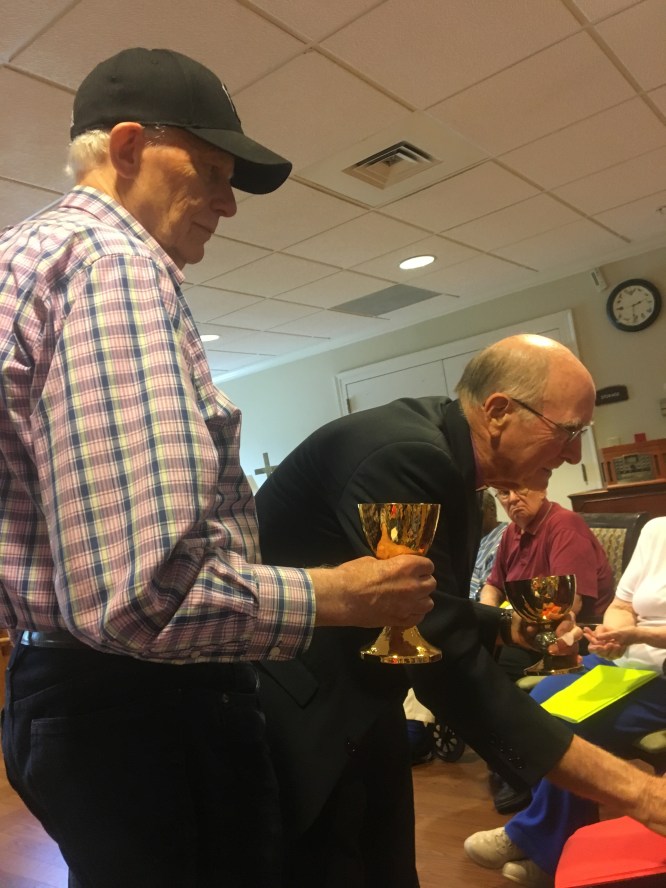
Yesterday, we celebrated Holy Communion at Bethany, the memory care facility. The mystery of the Sacrament is magnified when celebrated among people with dementia.

Two long-time, non-verbal residents who seldom respond when approached, eagerly received the elements for the first time during the three years I have served as chaplain. The look in their eyes communicated beyond words: “This is the bread of life!”

Being assisted by my neighbor and friend, Dale Sessions, is a special means of grace. Dale is an American Baptist clergy who is in mid-stage of his Alzheimer’s disease. He now lives totally in the present moment and his once extensive vocabulary has been reduced to very few words.

Dale and Communion

Dale’s very presence is a form of ministry; and the cup of salvation being held in his hands is a visible reminder that God’s salvation comes to and through the vulnerable and powerless among us.

Prayer for Lovingkindness

Clasping hands 2God of steadfast love and mercy, whose lovingkindness gives us life and fills the world with beauty and goodness: From the fountain of  your steadfast love flows forgiveness, patience, and forbearance toward us. We have drifted far from the boundless mercy and kindness which spring forth from the depths of your very being. Cruelty and crudeness, disrespectful and demeaning rhetoric dominate our public discourse; and we disregard the humanity of those with whom we disagree. Tame our vile tongues, soften our calloused hearts, open our closed minds, humble our arrogant spirits, and fill our whole lives with your lovingkindness. Create in us the mind and spirit that were in Christ Jesus, in whose name we pray. Amen
Prayer for God’s Dream

Prayer ImageRighteous and compassionate God, whose goodness and truth are unwavering and whose compassion remains steadfast: We cringe today before private and public corruption and blantant cruelty that threaten our nation and world. Dishonesty, greed, and hate are applauded while personal integrity, generosity, and compassion are viewed as weakness. Disturb our consciences, purge our greediness, and melt the hardness of our hearts. Grant us a renewed vision of your dream for the world:

• Where all people are treated with inherent worth and dignity as your beloved children
• Where all barriers among us are removed and the human family is one
• Where integrity and honesty prevail in private and public life
• Where creation is healed and enabled to flourish as you intend
• Where justice rolls down like waters and righteousness like a cascading stream and all are welcomed at your table of abundance
• Where your kingdom comes on earth as it is in heaven!

Through your grace, O God, empower us to live now in the light of your dream brought near in Jesus Christ, in whose name we pray. Amen

The “Voices from Below”

Dietrich Bonhoeffer is well known for his resistance to Nazism and subsequent martyrdom. Less is known about the influence on his thinking by a small community of disabled people called Bethel. Bonhoeffer spent significant time among these castaways as German society moved toward creating a “super race” by eliminating those with perceived genetic defects rending them as “life not worth living.”

The people who were considered “defective” because of their physical, psychological, and intellectual disabilities helped to shape Bonhoeffer’s basic principle for understanding reality.

In a world that worships at the altar of the hyper-cognitive and physically dominant, we would do well to hear Bonhoeffer’s call to learn “from below.”

“It remains an experience of incomparable value that we have once learned to see the great events of world history form below, form the perspective of the outcasts, the suspects, the maltreated, the powerless, the oppressed and reviled, in short for the perspective of the suffering. . . .That we come to see matters great and small, happiness and misfortune, strength and weakness with new eyes: that our sense for greatness, humanness, justice, and mercy has grown clearer, freer, more incorruptible; that we learn, indeed, that personal suffering is a more useful key, a more fruitful principle than personal happiness for explaining the meaning of the world in contemplation and action.”

Until we hear the voices “from below,” from “the least of these,” we will not hear the voice of God!

After all, God’s eternal Word became flesh in a helpless baby born of an unwed peasant teenager, who became an immigrant fleeing politically motivated violence, lived in obscurity for thirty years,  and was executed as a convicted criminal.

Perhaps we would do well to turn off the television, get off Facebook, silence talk radio for a while; and visit a homeless shelter, holding center for migrant families, the local jail or prison, nursing home, Alzheimer’s facility, hospital emergency room, or attend an AA meeting.

Yes, God’s voice may come “from above” but most often it comes “from below,” from the vulnerable, the powerless, the silenced!