Honesty: The Core of Character Matters

 My grandfather, Dave Walker, was one of my heroes. He died at age 67.  He was a simple man who could neither read nor write; yet, he was perhaps the kindest, wisest, and most honorable person I have known. The memory of an incident during my childhood recently resurfaced.

I was about eight years old. Granddaddy asked if I would like to walk to the store with him about a mile away. He bought me a candy bar along with his purchase of a bag of flour. After we were almost back home, he counted his money in the change purse he carried in the pocket of his overalls. He discovered the clerk had given him a nickel more change than he should.

“We have to go back to the store,” granddaddy said. “I have to return this nickel.”

“But it’s just five cents,” I said. “He’ll never even know he gave you too much!”

“But I’ll know,” he responded.  “You’re only as good as your word,” he added.

The most frequently heard compliments at my grandfather’s funeral in 1961 were these: 

            “He was honest as the day is long!”

            “His word was his bond!”          

“If he promised something, you could count on it.”

            “He never lied; he always told the truth.”

            “You could trust him with your life.”

I’ve thought a lot about my grandfather during the current climate of runaway dishonesty. Lying is being normalized, justified, trivialized, and weaponized in high and low places. Distortion of truth has become a contrived means of achieving desired ends.

In the current political climate, character has been disjoined from policy, as though favorable policies override personal integrity. Without character-embedded honesty, however, promises related to policy are fickle, hollow, and manipulative.

Granddad considered honesty the core of character and dishonesty as symptomatic of a malignantly diseased character. He learned that from Jesus! “Whoever can be trusted with very little can also be trusted with much, and whoever is dishonest with very little will also be dishonest with much” (Luke 16:10).

Fred Craddock shared an experience while in the buffet line at an airport food outlet. Dr. Craddock saw the man in front of him slide a small pad of butter under his plate, hiding it from the cashier. The butter only cost five cents! A harmless or inconsequential dishonest act! But Dr. Craddock commented that he kept his eyes on his own luggage when that man showed up at the same boarding gate. Trust was gone!

Dishonesty is a deadly infection of the soul that poisons every aspect of life. It destroys trust, corrodes character, fractures relationships, undermines community, and subverts the common good. Lies are like termites eating away the foundation or malignant cancer cells destroying vital organs, within individuals and society.

 Would you trust your children with the man who hid the pad of butter under his plate? Would you hire him as your financial advisor or banker? Give him a key to your car or house? Buy a used car from him? Give him the combination to your safe? Vote for him? Provide him with the nuclear code?

Albert Einstein is reported to have warned, “Whoever is careless with the truth in small matters cannot be trusted with important matters.”

Character matters! Granddaddy was right: “You are only as good as your word!” He not only believed it; he also LIVED it. He was as good as his word. I would trust him with my life!

Granddaddy’s change purse

Choosing Leaders

This election season challenges me to clarify the qualities of leadership that most closely reflect the core values of my faith, whether those being chosen are for government, the church, or institutions/agencies. Here are some qualities I look for. What’s on your list?

1. Personal Character and Temperament: truthfulness and reflections of “Fruits of the Spirit”: love, joy, peace, patience, kindness, generosity, faithfulness, gentleness, and self-control.” Leaders greatly influence the culture of the entity they lead. Power divorced from honesty, moral character, and mature temperament becomes manipulative, coercive, self-serving, and destructive, thereby thwarting the common good and inflicting suffering on others. 

2. Demonstrated Commitment to Justice as Equity, Fairness, and Enabling the Least and Most Vulnerable to Flourish as God’s Beloved Children. Developing and implementing policies that protect and enable the powerless to have access to God’s table of abundance strengthens the whole society. Merely protecting and advancing the privileges of the privileged fails the justice test and results in exploitation, inequity, abuse, and even death.

3. Proven Recognition of and Respect for the Inherent Worth, Dignity, and Wellbeing of Every Person. Leaders set the tone for how those they influence treat others. Using a biblical image, leaders are shepherds who know, defend, nurture, preserve, and guide others. On the other hand, “hirelings” fleece, exploit, abandon, deplete, and may even slaughter the sheep. The shepherd recovers and restores the weak; the hireling scatters and disregards the vulnerable. 

4. A Disciplined, Tough Mind and a Compassionate, Empathetic Heart. This is what Jesus described as being “wise as serpents and harmless as doves.” Leaders must exhibit both intellectual and social intelligence. Intellect without empathy humiliates and demeans; empathy without intellect risks enabling destructive behavior and being co-opted for nefarious purposes.

5. Compelling Vision for the Common Good and Sensible Strategy for Moving Toward the Vision. For me, the vision is defined in the biblical images of “the kingdom of God” and “the New Creation;” and it is embodied in the life, teaching, death, and resurrection of Jesus the Christ. Components include these:

▪ the dignity and worth of ALL persons are respected, preserved and nurtured.

▪ the interrelatedness, interdependence, and mutual flourishing of creation is respected.

▪ the oneness and unity of the human family is reflected in actions and policies.

▪ service ranks above profits, restoration surpasses retribution, and hope defeats despair.

I realize that no one fully embodies these qualities, and they may seem idealistic and unattainable. Admittedly, they are more aspirational than concretely visible in our polarized, fragmented, and violent world.

Yet, we need leaders at all levels whose aspirations transcend mere self-interest, acquiescence to things as they are, and cynical scorning of such ideals as freedom, compassion, respect, and justice for ALL.
                

Trying to Make Sense of My Life

I’ve spent much time in recent years remembering and reflecting on events, relationships, and stories that have shaped who I am. It says a lot about my station in life. I’m poignantly aware of having exceeded by more than a decade my biblically allotted “three score years and ten.”

A few colleagues and several family members, including grandchildren, urged me to share stories from my life and more than sixty years of ordained ministry. It has been a daunting, emotional, frustrating, and yet healing process.

Reliving past struggles, mistakes, failures, hurts, griefs, disappointments, and losses resurfaces unresolved guilt and regrets. The grace I have proclaimed for six decades has been put to a test as a lived reality. Accepting forgiveness for myself is sometimes harder than extending it to others.

But the process of remembering, reflecting, and writing has been predominantly a source of healing, thanksgiving, and hope. I am in awe of the ineffable mystery and resilience of life. Each person’s finite story is mysteriously interwoven into an Infinite Story with limitless connections and possibilities.

Seemingly inconsequential events, encounters, or decisions in retrospect were life-transforming. “What ifs” are part of remembering: What if I had not gone to that conference? What if I had said “no” to a particular invitation? What if I had not enrolled in that school, or taken a different class, or entered an alternative vocation?

Life is a mysterious combination of choices made and conditions prescribed, situations over which we have control and circumstances beyond our control, the “givens” of nature and the influence of nurture.

Life is simply too complex, too interrelated, and mysterious to be fully described. Memory never records the totality of any incident and recall always reflects current contexts as much as the event itself.

Therefore, writing a memoir requires a stance of vulnerability and humility in remembering and interpreting the circumstances, experiences, events, perceptions, and relationships that constitute one’s life. The process is risky and fraught with temptations for distortion and misrepresentation.

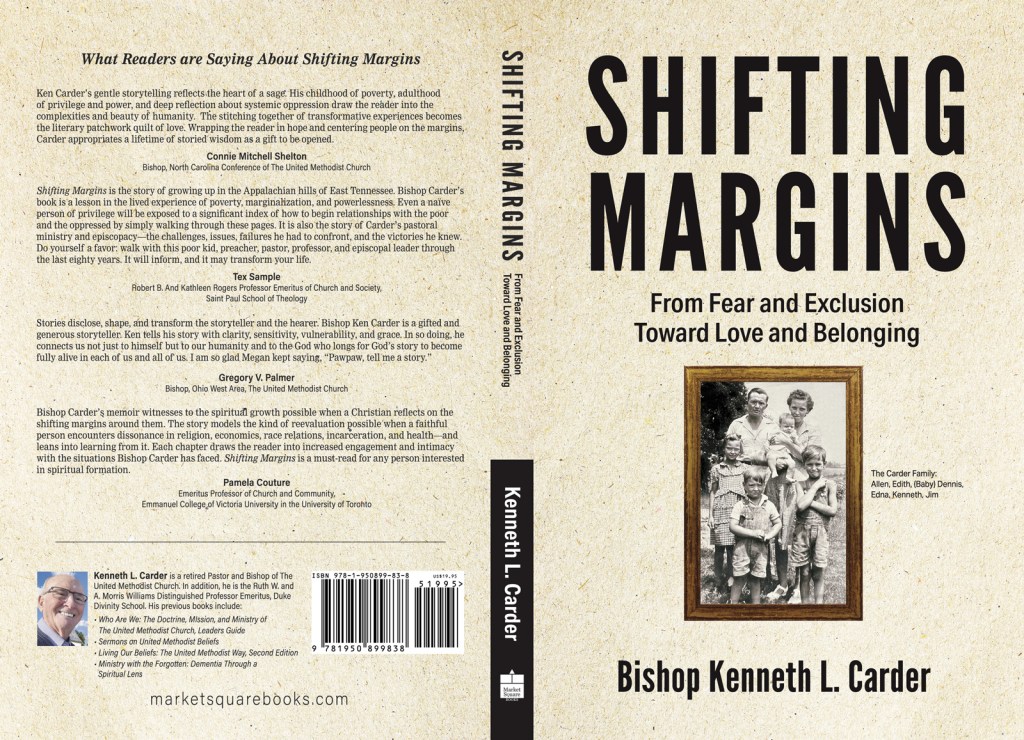
The book, Shifting Margins: From Fear and Exclusion to Love and Belonging is my attempt to make sense of my own life. It began with simply putting memories on paper, starting with my earliest recalled experiences and moving through seven decades. Reviewing journals and accumulated files of correspondence and other documents resurfaced forgotten events, transitional experiences, and relationships. The result was almost six hundred pages!

With the help of a skilled editor (who happens to be my daughter), identifying themes, and creating a coherent and readable manuscript followed. Reducing the manuscript by two-thirds became symbolic of my reality. Life’s experiences are narrowing. The circle of engagement and involvement is diminishing. Physical energy is declining. Cognitive functioning remains but with less quickness and retention. The end is far closer than the beginning!

After all this remembering and reflecting, I have concluded that perhaps the goal isn’t to make sense of life. Rather, it is to participate in its unfolding mystery with love, perseverance, and hope.

Whatever the stage, there are opportunities to give and receive love. There are challenges to confront with determination and courage. There is hope that our stories ultimately fold into God’s Story of Endless Love and Resurrection Life.

To order Shifting Margins, https://www.marketsquarebooks.com/store/p123/Shifting_Margins.html

“Betrayed with a Kiss and a Sword”

Jesus asked the piercing question of the disciple-turned-conspirator: “Judas, is it with a kiss that you are betraying the Son of Man?” (Luke 22:48)

Why a kiss? Would not a slap or pointed finger or clinched fist be more appropriate means of betraying Jesus into the hands of his opponents? But, no! Judas betrayed with a sign of affection!

Upon closer reflection, however, Jesus’ question is appropriate for all who claim allegiance to him. We rarely, if ever, hear expressed outright hatred or denunciation of Jesus. Yet, we all betray!

Most often our betrayal takes the form of declared affection for Jesus. Here are a few ways we betray Jesus with a kiss:

  • Singing “O How I Love Jesus” while hating those who are different
  • Declaring “Jesus Is Lord” while prioritizing partisan politics above the common good
  • Claiming Jesus’ forgiveness but holding grudges and seeking vengeance
  • Affirming love for God while despising neighbors near and far
  • Singing “Jesus Loves the Little Children, All the Children of the World” while failing to provide all children with access to education, medical care, safety and love
  • Proclaiming “God is Love” with anger in our voices and hate in our actions
  • Assert that Jesus is ‘the way, truth, and life’ and refuse to obey his command to love one another as he loves us
  • Saying “Lord, Lord” and failing to do what he says, go where he goes, and welcome those whom he loves

Judas resides in all of us!  We, too, betray with a kiss!

But Judas wasn’t the only disloyal disciple present in the garden when Jesus was arrested. Luke tells us, “One of them struck the slave of the high priest and cut off his right ear”(22:50).

Jesus responded resolutely, “No more of this!”

The kiss and the sword have much in common as forms of betrayal. History is replete with efforts to violently defend Jesus.

The Crusades were fought in name of loyalty to Jesus. Scientists were burned at the stake under the guise of protecting religious doctrine. Preachers used the Bible to promote slavery! Klansmen terrorized and murdered with burning crosses and prayers of devotion to Jesus. The Bible has been used as a sword of discrimination against women.

Defending Jesus with physical, verbal, and emotional swords is a pervasive means of betrayal. Could these be subtle contemporary examples of betrayal with swords?

  • Using Scripture as a weapon for exclusion, hatred, and discrimination
  • Promoting hatred of Muslims, immigrants, gays, and others in the name of defending the Christian faith
  • Applauding the Sermon on the Mount while defending possession of assault weapons as a “God-given right”
  • Proclaiming God’s preferential presence in “the least of these” while advocating public policies that damage the poor, vulnerable, and powerless
  • Increasing spending for weapons of war while decreasing support for education, healthcare, housing, and food for the under resourced

But the final word in the Christian gospel isn’t betrayal! It’s forgiveness, reconciliation, and healing.

In Matthew’s account of Judas’ betrayal, Jesus calls him “friend.” Judas’ kiss may have been betrayal, but Jesus’ response was one of steadfast love.

After admonishing the disciples against violence, Jesus healed the victim. The final word was/is healing, not violence.

From the cross, Jesus spoke the ultimate response to all forms of betrayal: “Father, forgive them; for they do not know what they are doing” (Luke 23:34).

Whether betrayed with a kiss or a sword, Jesus forgives, reconciles, transforms.

Book to be Released April 1

Shifting Margins: From Fear and Exclusion Toward Love and Belonging, will soon be available. The official release date is set for April 1.

It will be available in all the usual places (Amazon, Cokesbury, etc.) and on the publisher’s online store at marketsquarebooks.com.

In the book, I share stories from my life and ministry as I moved from poverty to privilege, from a rigid religion of fear to a faith grounded in grace and love, from segregation and prejudice to justice and inclusion, from centers of power to society’s margins, from autonomy and control to community and belonging.

While the book is officially available on April 1, the publisher, Market Square Books, is offering the book for pre-order fifteen percent discount until March 30:

https://www.marketsquarebooks.com/…/Shifting_Margins.html

When placing an order, feel free to use the following discount code to receive a 15 percent discount: shifting

Did Baby Jesus Cry?

During a Christmas visit with grandchildren almost twenty years ago, our preschool granddaughters were role playing the nativity. Megan and Emily took turns playing Mary, and I was enlisted to be Joseph. The pretend baby Jesus was a plastic doll that mechanically made baby sounds.

Megan pushed the sound button, and the baby began to cry. She gently cradled Jesus in her arms and tenderly said, “It’s all right, Baby Jesus. Don’t cry.”

Emily responded emphatically, “Megan, baby Jesus didn’t cry!” A profound theological discussion between cousins ensued.

“Yes, he did cry. All babies cry,” Megan said confidently.

“But Jesus was different. He wasn’t like all babies,” thoughtfully countered Emily.

“I know he was different, but he still cried,” protested Megan.

They then glared toward the pretend Joseph to settle the dispute. Little did they realize they were engaging in a vexing centuries-long theological quandary:  the mystery of the Incarnation, the eternal God becoming flesh in a vulnerable little baby.

Emily was right! Jesus is truly different! He is the Son of God, the Logos/Word made flesh, Emmanuel, God with us!

Megan was also correct! Jesus was truly human. Baby Jesus did cry! He nursed at Mary’s breast, had his diaper changed, suffered, and died!

Emily’s declaration that baby Jesus didn’t cry likely came from the Christmas carol, “Away in a Manger.” It’s understandably popular, especially among children. The second verse contains these words, “The cattle are lowing, the baby awakes, but little Lord Jesus, no crying he makes….”

It’s a lovely carol, but it falls short of expressing the meaning of the Incarnation by denying the full humanity of Jesus. In fact, such an interpretation was declared a heresy and runs counter to the New Testament witness.

Jesus cried when his friend Lazarus died (John 11:35). He wept over the city of Jerusalem (Luke 19:41). I suspect that he wept often throughout his life as he experienced the inevitable pain, disappointment, loss, disappointment inherent in being human. Furthermore, as the Christ, his weeping continues for a world filled with grieving people and wayward cities.

Why is it important to note that baby Jesus cried? It is tempting to deny the humanity of Jesus and thereby remove him from the real world of human beings with all our struggles. It is far easier to sentimentalize the baby Jesus than it is to humbly enter the profound mystery of God coming among us as a vulnerable, helpless, whimpering baby.

Only a baby Jesus who cries and an adult Jesus who weeps can be the Savior of a broken, suffering, sorrowful, sinful, and weeping humanity. Only a Jesus who cries can understand and redeem our tears.

The Gift of Presence

The absence of loved ones is keenly felt during this season when presence with family and friends dominants expectations and schedules. Yet, Advent/Christmas is about Presence amid Absence as God enters the darkness and absence in the form of Incarnate Love. Norma Sessions beautifully captures the essence of that comforting presence amid haunting absence.

Norma Sessions's avatarImages and Reflections

As the anniversary of Dale’s passing approached, the “lasts” grew vivid. Remembering the evening I last heard his voice was the most painful. His exuberant presence had always filled a room; his absence created a cavern.

A loved one described it well: “There’s such gone-ness.”

That sense of void dominated my early days of grieving.

I had thought that the many losses of the previous decade would prepare me for this final one. With each disease-related change, there was an aspect of Dale that I missed. I had learned to live with absence amid presence.

But there was no preparation for the final loss: Complete absence. Emptiness. “Gone-ness.”

There were times when the darkness and emptiness seemed total…when the absence felt too much to bear. I missed him—every version of him. I still do. However, now I see that throughout these months, I have been accompanied. Although…

View original post 221 more words

All means ALL!

All means ALL! To treat some as less than–or as an aberration or abomination–is in violation of the Gospel and incompatible with Christian teaching.

I preached these words at First United Methodist Church in Oak Ridge, Tennessee (website) on November 20, a pivotal Sunday in the liturgical year and in this congregation’s history.

Christ the King Sunday pivots the liturgical year from the culmination of Pentecost to the expectancy of Advent. Added to the significance of this particular Sunday was the fact that this was the congregation’s first opportunity to vote on whether to join the Reconciling Ministries Network (website). A “Reconciling congregation” openly welcomes all, including LGBTQIA+ people, into the full life and leadership of the church.

It is a pivotal period in my own life too! I just marked my 82nd birthday and my 62nd year of ministry in The (United) Methodist Church. It has been an ever-expanding journey from narrow provincialism, rigid moralism, and dogmatic exclusivism to a sense of mystery before an expanding cosmos created by a loving God; ongoing experiences of grace upon grace; and ever-deepening friendship with Jesus the Christ, who is “all in all.”

Since Christ is all in all and has reconciled all things, the usual categories by which we evaluate people and build dividing walls of hostility and exclusion no longer apply.

“There is no longer Greek and Jew, circumcised and uncircumcised, barbarian, Scythian, slave or free,” male or female, gay or straight, traditionalist or progressive, liberal or conservative, Democrat or Republican! All are one as beloved children of God.

Here is the link to the service. The sermon begins at approximately 39 minutes, but I encourage you to experience the entire service.

https://www.youtube.com/watch?v=kN0VvaIVEtE

“What’ll I Do…

This latest blog by Norma Sessions has implications beyond the grieving process. What do we do when life feels disorienting and uncertain?

Norma Sessions's avatarImages and Reflections

…when you are far away, and I am blue, what’ll I do?“

I found myself humming this Irving Berlin song recently, and then realized that the lyrics reflect my feelings as I adjust to life without Dale. What will I do? How do I fit in this world without you?

Although episodes are not as intense or as frequent as they were in the early months of grieving, there are still times when I feel acutely disoriented. In my mind’s eye, I see myself flailing about, as if suddenly swept up by an ocean wave, and I struggle to find my footing, to sense anything solid.

The physical presence of the one who so often extended his hand to help me with balance is gone.

Not only is he gone, but my daily focus—my purpose, even—is gone, too. During the last years of Dale’s life, my role as…

View original post 217 more words

Where Are You?

This is one of the most beautiful and meaningful expressions of the grieving process that I have read. It poignantly describes my own journey as I seek to weave the love Linda and I shared for sixty years into the fabric of a future without her presence. Norma Sessions has a special gift for using images to capture the deepest and most profound insights and experiences.

Norma Sessions's avatarImages and Reflections

I was at a meeting for Alzheimer’s caregivers when Dale called. There was fear in his halting voice: “Where…are…you?”

It was a first.

It was also a last. I could no longer leave him alone.

Now I am alone, and Dale’s words are mine: Where are you?

Weren’t you just here? Wasn’t I just preparing your lunch…singing and laughing with you…helping you get ready for bed? Where are you?

Although the words come directly from my grieving heart, they also seem crazy. I was with Dale when he died. I composed his memorial service. I helped bury his ashes.

And yet, the feeling that he should still be here can be strong. It’s easy to “hear” his resonant voice, to “see” him sitting next to me, or to just assume he’s resting in another room. All of our years…working, living, loving together…wove countless threads of a shared life throughout my…

View original post 197 more words