Artist Captures Mystery of Love’s Connections Amid Dementia

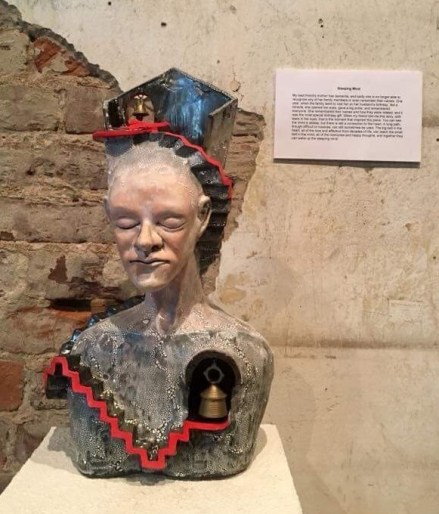
I was deeply touched by this ceramic work of art created by my daughter’s friend, Olga Yukhno. This particular sculpture was inspired by our family’s story of what we call “the birthday miracle of 2016.” Olga’s thought-provoking creation captures the mystery of the diseases that fall under the category of “dementia;” and it is testimony that the very BEING of people with dementia call forth our creativity, love, and gratitude. Below is Olga’s description of “The Sleeping Mind.”

Sleeping Mind

Sculpture by Olga Yukhno, Five Peaks Studio Art

Sleeping Mind

My best friend’s mother has dementia, and sadly she is no longer able to recognize any of her family members or even remember their names. One year, when the family went to visit her on her husband’s birthday, like a miracle, she opened her eyes, gave a big smile, and remembered everyone. She remembered their names and how they were related, and it was the most special birthday gift. When my friend told me this story, with tears in her eyes, that is the moment that inspired this piece. You can see the mind is asleep, but

there is still a connection to the heart. A long path, though difficult to traverse, can still sometimes be used. The big bell in the heart, all of the love and affection from decades of life, can reach the small bell in the mind, all of the memories and happy thoughts, and together they can wake up the sleeping mind.                   — By Olga Yukhno

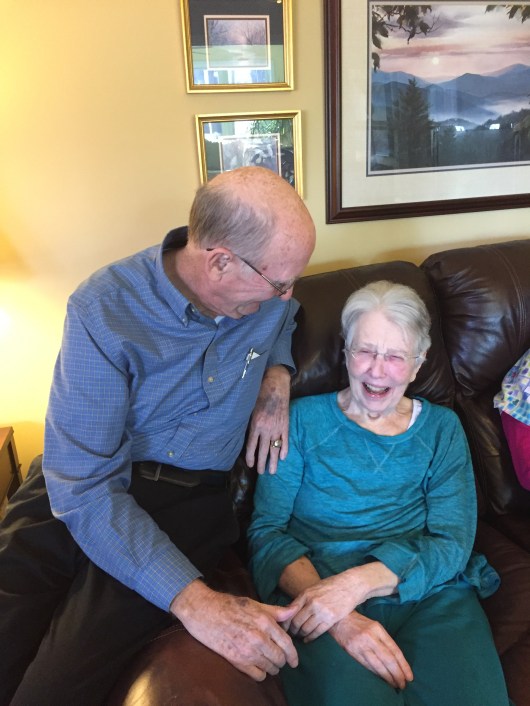
Linda awakens to know her family and dog!        November 18, 2016


This sculpture, along with other sculptures by Olga Yukhno, is part of a series called “What Moves Us” and is now on display through September at Anastasia and Friends Art Gallery (more information here on gallery and Olga Yukhno)

Prayer for Those Who Have Too Much

praying-hands_1027_1024x768

Abundant and generous God: your goodness is beyond measure; your power knows no limits except that which you impose; your bounty includes all that exists; your truth exceeds our comprehension; and your beauty is inexhaustible. We stand in awe before your inexhaustible greatness.

We acknowledge your provision for us and your preferential presence with those to have too little–the poor, the oppressed, the powerless, the vulnerable, the sick.

We pray today for those who seem to have too much, and thereby suffer from spiritual, moral, and ethical poverty:

  • those with so much wealth that they are blind to the plight of the poor
  • those with so much power that they exploit the powerless
  • those with so much health that they think they are invincible
  • those with so much intelligence that they lack wisdom
  • those with so much prestige that they lack humility
  • those with so much religion that they fail to be good
  • those with so much hate that they no longer love

Forgive us, merciful God, for assuming we are god and failing to live as though life is a gracious gift. You call us to be faithful stewards of your gifts and to welcome ALL to your table of abundance.

Grant us the mind that was in Christ Jesus–the humble mind, devoted to loving, seeking, and serving those who have too little. Remind us again that without self-giving love, we have nothing. Amen.


Let’s Remove Stigma from Dementia

 ” Dealing with early stage Alzheimer’s, I’ve found the hardest part is the stigma that comes with it. Friends don’t come around as often. Is this true?????,” wrote a friend.

care-97984_1280“Don’t tell anybody! I don’t want anyone to know,” pleaded Linda when in 2009 we received word that she has Frontotemperal Dementia (FTD).
“They’ll treat me differently. They will think I’m crazy,” she added.

Studies indicate that people fear dementia more than they fear cancer, and even death itself.

When asked what they fear the most, the answers vary: loss of control, loss of identity, “being a burden,” not remembering family, being treated differently, what other people will think.

A societal problem undergirds those fears, and it’s the stigma associated with the disease. Our hyper-cognitive, capacity-reliant  society diminishes the personhood and worth of people with cognitive impairments.

Even the word “dementia” contributes to the stigma. It literally means “loss of mind” and the dictionary lists the following among the synonyms: ”madness,” “insanity,” “derangement,” ”lunacy.”

Dementia is an umbrella term that covers multiple diseases that affect cognitive functioning, with Alzheimer’s disease comprising between sixty to eighty percent. Indeed, changes in the brain contribute to the diseases.

But dementia is more than a brain disease. Dementia is a social-relational disease; and the stigma society attributes to people with cognitive impairment contributes to its destructive consequences.

Stigmatizing people with Alzheimer’s and other forms of dementia may be more damaging than the pathology at work in the brain. Stigma contributes to isolation and diminished sense of self-worth.

There should be no more stigma associated with Alzheimer’s and other forms of dementia than with heart disease, diabetes, or any other disease. As with other diseases, those causing cognitive impairment are no respecter of persons’ class, education, race, prestige, or reputation.

All of us can contribute immeasurably to diminishing the suffering of those with Alzheimer’s and other forms of dementia. We can help remove the stigma!

Whatever our infirmities or frailties, we are ALL beloved children of God with inherent worth and dignity, and worthy of respect, relationships, and belonging.

Communion at Bethany

Yesterday, we celebrated Holy Communion at Bethany, the memory care facility. The mystery of the Sacrament is magnified when celebrated among people with dementia.

Two long-time, non-verbal residents who seldom respond when approached, eagerly received the elements for the first time during the three years I have served as chaplain. The look in their eyes communicated beyond words: “This is the bread of life!”

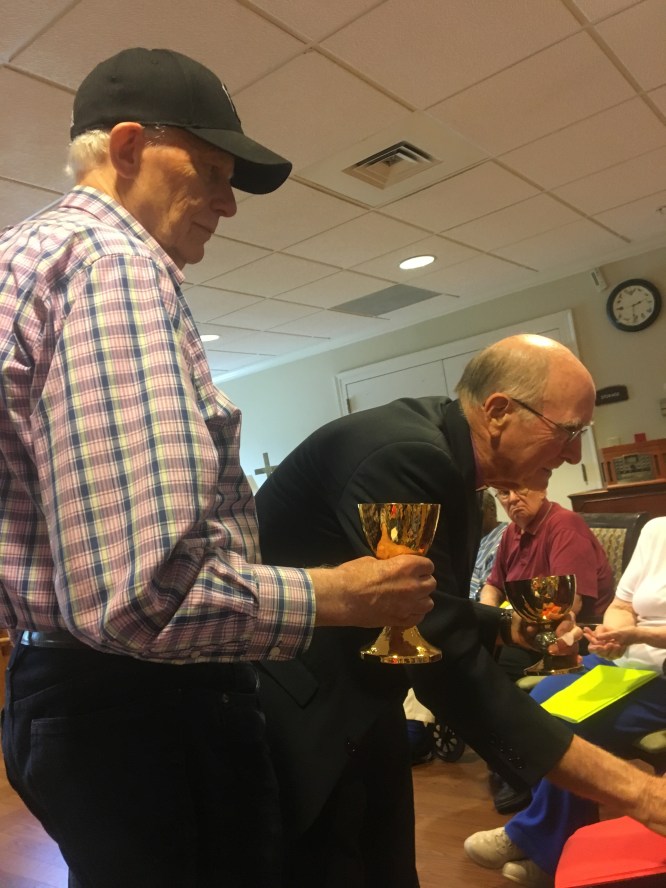
Being assisted by my neighbor and friend, Dale Sessions, is a special means of grace. Dale is an American Baptist clergy who is in mid-stage of his Alzheimer’s disease. He now lives totally in the present moment and his once extensive vocabulary has been reduced to very few words.

Dale and Communion

Dale’s very presence is a form of ministry; and the cup of salvation being held in his hands is a visible reminder that God’s salvation comes to and through the vulnerable and powerless among us.

Prayer for Lovingkindness

Clasping hands 2God of steadfast love and mercy, whose lovingkindness gives us life and fills the world with beauty and goodness: From the fountain of  your steadfast love flows forgiveness, patience, and forbearance toward us. We have drifted far from the boundless mercy and kindness which spring forth from the depths of your very being. Cruelty and crudeness, disrespectful and demeaning rhetoric dominate our public discourse; and we disregard the humanity of those with whom we disagree. Tame our vile tongues, soften our calloused hearts, open our closed minds, humble our arrogant spirits, and fill our whole lives with your lovingkindness. Create in us the mind and spirit that were in Christ Jesus, in whose name we pray. Amen

Splitting the Church is Just “Tacky”

© Ivan Grlic, Dreamstime


Thoughts of splitting The United Methodist Church trouble me for a host of reasons Some theological and missional.

This polarized and violent world desperately needs the witness of a community that grapples with disputes and differences with humility, mutual respect, and compassion. While divisions have been part of our heritage since the beginning, they never bode well for our commitment to oneness in Christ Jesus.

We need one another, whatever our labels. God has already reconciled us! We have been made one, whether we like it or not. So, I don’t quite understand why we can’t live the reconciliation already accomplished in Christ. If Christ has made us one, should we not live that oneness?

But I’m also troubled for personal reasons.

I’ll always remember that fateful Sunday morning almost 65 years ago when this son of Appalachian tenant farmers and textile workers walked shyly into a Sunday school class at McKinley Methodist Church.

Mrs. Mahoney greeted me at the doorway with a warm hug. I remember the Bible story she told that day. It changed my image of God and set me on a life-long quest to love, trust, and serve God. It was the story of the Good Shepherd. I can still hear her say, “God is like that shepherd.”

That was radically different from the messages I had been hearing in the church of my early childhood. I had the notion that God was like that cruel landlord who once dangled me over a rain barrel to “teach me to respect” him. God was the strict judge who expected, above all else, our respect and obedience. Eternal damnation awaited those who lacked such deference and compliance.

Mrs. Mahoney introduced me to a God who delights in rescuing little lost lambs, a God who invites us to share in the search and saving of the least, the lost, and the wayward. She invited me into friendship with Jesus, a friendship rooted in love not fear.

McKinley Methodist Church became my spiritual home as an adolescent. There I was baptized and received into membership. It was there that I:

• Received a new identity (beloved child of God)
• Learned I didn’t have to take the Bible literally to take it seriously
• Was elected to my first church office (president of the MYF)
• First spoke publicly before a group
• Had my first for-pay job (janitor)
• Taught my first class (Vacation Bible School)
• Was called into ordained ministry
• Introduced to the church as connectional (we were on a circuit)
•Selected to attend the National Youth Conference where I heard an African    American preacher for the first time (James Thomas)
• Approved for candidacy and granted a local preacher’s license

At a conference youth assembly, I met my beloved wife, Linda. We were married in the Methodist Church. She was educated in a Methodist college. We attended a Methodist seminary and spent 42 years living in homes provided by the church. Our daughters and grandchildren have been baptized in United Methodist Churches.

I’ve been privileged to serve eight wonderful congregations and two strong episcopal areas. Additionally, I have taught in a United Methodist seminary, sat on the governing boards of numerous United Methodist related institutions and agencies, experienced the world-wide mission of the church while visiting in Africa, Europe, Asia, and Latin America.

All of this is to say, it’s impossible for me to sever my life from that of the denomination in which I have been and continue to be formed.

To me the reasons being advanced for splitting the denomination seem extraneous to the core Christian gospel and the church’s mission in this polarized and violent world filling up with lost lambs.

When I entered McKinley Methodist Church as a child of poverty, I wasn’t looking for dogmatic pronouncements. I was longing for a community in which I was accepted, valued, and loved. I wanted a place to grow in my understanding of and friendship with God. And, I needed a purpose worth my life.

The church I joined gave me room to grow, and I’m still growing. It moved me beyond provincialism, challenged my racial prejudices and patriarchal practices, gave me a theological lens through which to view every aspect of life, anchored me in sound doctrine while encouraging continuing theological exploration, extended the horizons of God’s salvation to include the healing and transformation of human hearts, communities, nations, and the entire cosmos.

I’m not worried about the survival of the Church. The Body of Christ has been raised from the dead and the gates of hell will not prevail against it. And, I know the institutional form which the body of Christ takes is always changing.

But dividing The United Methodist Church into “Progressives” and “Traditionalists” is just plain wrong. As the late Will Campbell said about the death penalty, “I just think it’s tacky!”

A Word to the President

Words-Matter-People-Development-NetworkPresident Trump denouncing all forms of racism and violence is like an arsonist denouncing the fire he poured gasoline on. Please, Mr. President, stop the cruel, hate-filled, demeaning rhetoric. You’re fanning the flames of hatred, racism, and violence that are spreading like wildfire across our land. Words matter!
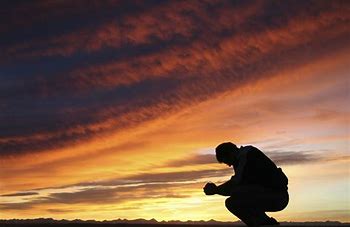
Prayer for God’s Dream

Prayer ImageRighteous and compassionate God, whose goodness and truth are unwavering and whose compassion remains steadfast: We cringe today before private and public corruption and blantant cruelty that threaten our nation and world. Dishonesty, greed, and hate are applauded while personal integrity, generosity, and compassion are viewed as weakness. Disturb our consciences, purge our greediness, and melt the hardness of our hearts. Grant us a renewed vision of your dream for the world:

• Where all people are treated with inherent worth and dignity as your beloved children
• Where all barriers among us are removed and the human family is one
• Where integrity and honesty prevail in private and public life
• Where creation is healed and enabled to flourish as you intend
• Where justice rolls down like waters and righteousness like a cascading stream and all are welcomed at your table of abundance
• Where your kingdom comes on earth as it is in heaven!

Through your grace, O God, empower us to live now in the light of your dream brought near in Jesus Christ, in whose name we pray. Amen

The “Voices from Below”

Dietrich Bonhoeffer is well known for his resistance to Nazism and subsequent martyrdom. Less is known about the influence on his thinking by a small community of disabled people called Bethel. Bonhoeffer spent significant time among these castaways as German society moved toward creating a “super race” by eliminating those with perceived genetic defects rending them as “life not worth living.”

The people who were considered “defective” because of their physical, psychological, and intellectual disabilities helped to shape Bonhoeffer’s basic principle for understanding reality.

In a world that worships at the altar of the hyper-cognitive and physically dominant, we would do well to hear Bonhoeffer’s call to learn “from below.”

“It remains an experience of incomparable value that we have once learned to see the great events of world history form below, form the perspective of the outcasts, the suspects, the maltreated, the powerless, the oppressed and reviled, in short for the perspective of the suffering. . . .That we come to see matters great and small, happiness and misfortune, strength and weakness with new eyes: that our sense for greatness, humanness, justice, and mercy has grown clearer, freer, more incorruptible; that we learn, indeed, that personal suffering is a more useful key, a more fruitful principle than personal happiness for explaining the meaning of the world in contemplation and action.”

Until we hear the voices “from below,” from “the least of these,” we will not hear the voice of God!

After all, God’s eternal Word became flesh in a helpless baby born of an unwed peasant teenager, who became an immigrant fleeing politically motivated violence, lived in obscurity for thirty years,  and was executed as a convicted criminal.

Perhaps we would do well to turn off the television, get off Facebook, silence talk radio for a while; and visit a homeless shelter, holding center for migrant families, the local jail or prison, nursing home, Alzheimer’s facility, hospital emergency room, or attend an AA meeting.

Yes, God’s voice may come “from above” but most often it comes “from below,” from the vulnerable, the powerless, the silenced!


Prayer for Humility

humble_prayer

Wondrous God, who brings this ever-expanding universe into existence and imbues it with unfathomable mystery and boundless goodness: We stand in awe that you have created us from the dust of the earth, stamped your image upon us, and breathed into us your spirit. We marvel that you number the hairs of our head and mark a sparrow’s fall. “O Lord, our Lord, how excellent is thy name in all the earth!” May the vision of your glory and majesty dissolve our pride and arrogance. Free us from a closed mind and a grudging spirit which blind us to mystery and poison our spirits. Grant us the humility to acknowledge that our perceptions fall short of the fullness of your truth and goodness. Give us openness of mind and generosity of spirit, so  we can see you more clearly, love you more fully, and serve you more faithfully.  Through your Holy Spirit, create in us the mind and magnanimity that were in Christ Jesus, in whose name we pray. Amen