A Journey Toward Reconcilation with LBGTQ+ Friends

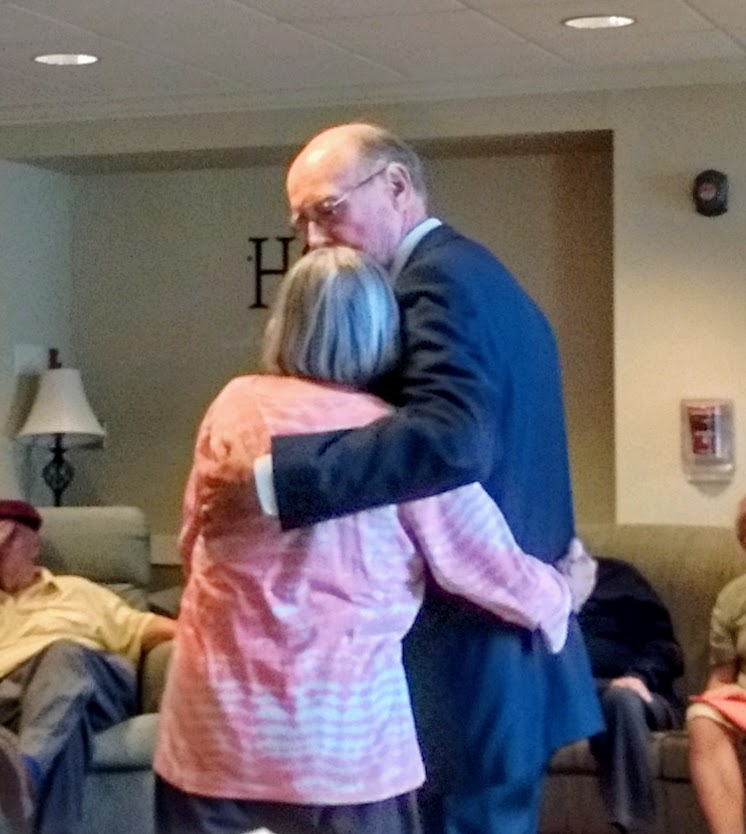
Elaine Eberhart and I have been friends since the mid-1980s when we served together on the pastoral staff of First UMC in Oak Ridge, Tennessee. As a delegate to General Conference in 1984, I regrettably voted for the legislation that prohibited the ordination of “self-avowed practicing homosexuals.” A few years later, Elaine surrendered her ordination in an act of integrity and courage.

Elaine’s grace-formed life and faithful witness contributed to my conversion and growth as a person, a Christian disciple, pastor, bishop, and teacher. In 2018, I wrote a short blog on why I changed my mind. Though Elaine was not specifically named, she is prominently among those who contributed immeasurably to my changed perspective and commitment. The blog received more than seventy thousand views. You may access it here: https://shiftingmargins.com/2018/09/25/why-i-changed-my-mind-about-homosexuality-and-the-church.

I continue to repent of the harm inflicted on LBGTQ+ siblings by my complicity and failure of leadership. Elaine has graciously extended her forgiveness, and our friendship has deepened. Although she has had a marvelously productive ministry as a lay person in such institutions as Emory University, Mayo Clinic, and the University of Tennessee, I regret that her exceptional gifts as a United Methodist pastor went unutilized.

In June 2025, I was among those who shed tears of joy as Elaine’s clergy credentials were restored by the Holston Annual Conference. It was a momentous occasion, a visible sign and foretaste of God’s reign of justice, reconciliation, and transformation.

You are welcome to join us on December 9 by zoom as Elaine and I engage in conversation. On this webinar, we share our story in hopes that our journey might be helpful to others who seek to experience the reconciliation so desperately needed in our world and church.

This free webinar is for both laity and clergy and will be held December 9, 2025, from 2 pm to 3 pm. To receive the link for the webinar, please register here https://clergyeducation.com/events/2512carder/.

Blessed Are the Peacemakers

Dr. Bill Holmes (right)

As I continue my daily reading of the Sermon on the Mount and reflections on its resonance and dissonance in my daily experience, I share this story about my friend, Dr. Bill Holmes. While war rages in Ukraine and elsewhere, Bill was presented with the Muslim Americans for Compassion award “In recognition of service to compassion, promoting peace, and interfaith harmony.”

As the media is filled with news of violence and war as the way to lasting peace, Bill Holmes contributes to peace through compassion, non-violence pursuit of justice, and promoting interfaith harmony.

Bill is a highly regarded pediatric neurologist and an ordained Baptist hospital chaplain. Our friendship was forged through shared grief as we journeyed with our late spouses in their dementia. He is one in whom I see the Beatitudes and Sermon on the Mount validated and at work as a counter to hatred, division, and violence normalized in the modern world.

With his permission, I share Bill’s response to receiving the award. His brief statement captures his deep commitment to justice and compassion which are at the heart of Jesus’ “inaugural sermon” in Matthew’s Gospel.

Remarks to Muslim Americans for Compassion and the 15th Annual Interfaith Iftar Dinner after receiving an award “In recognition of service to compassion, promoting peace, and interfaith harmony.”  March 6, 2025

 I stand here this evening wondering why I, of all people, should get an award for peacemaking. If my mother were alive today, she would be astounded.

Jeremiah of ancient times cried “Peace! Peace! But there is no peace.” Patrick Henry borrowed those words a few thousand years later to let his country men know that the battle against tyranny was already here.

We all long for peace within our hearts and souls and peace in the community around us.

But there is a pre-requisite to peace: First there MUST BE JUSTICE.  Where there is justice, all in the community have what is needed for dignity, freedom, health, joy, and security.

There can be no justice when this group or that is singled out and treated harshly. Nor can there be justice when the safety and health of our children and grandchildren are being threatened.   

We cannot have peace while ignoring injustice.

Where there is no justice, peace becomes a mirage.  

Please know this: Hate and fear are the parents of injustice.

Furthermore, without justice and lasting peace, we might well lose hope.

It is now our task to somehow bring hope, even in the midst of despair that might befall as we see the scales tipping toward injustice all around us.

Thanks for listening—  As-Salamu alaykum, Peace be with you.

Peace, my friends, will always be tenuous, will always be fragile, and must be protected like a newborn baby.

Choosing Leaders

This election season challenges me to clarify the qualities of leadership that most closely reflect the core values of my faith, whether those being chosen are for government, the church, or institutions/agencies. Here are some qualities I look for. What’s on your list?

1. Personal Character and Temperament: truthfulness and reflections of “Fruits of the Spirit”: love, joy, peace, patience, kindness, generosity, faithfulness, gentleness, and self-control.” Leaders greatly influence the culture of the entity they lead. Power divorced from honesty, moral character, and mature temperament becomes manipulative, coercive, self-serving, and destructive, thereby thwarting the common good and inflicting suffering on others. 

2. Demonstrated Commitment to Justice as Equity, Fairness, and Enabling the Least and Most Vulnerable to Flourish as God’s Beloved Children. Developing and implementing policies that protect and enable the powerless to have access to God’s table of abundance strengthens the whole society. Merely protecting and advancing the privileges of the privileged fails the justice test and results in exploitation, inequity, abuse, and even death.

3. Proven Recognition of and Respect for the Inherent Worth, Dignity, and Wellbeing of Every Person. Leaders set the tone for how those they influence treat others. Using a biblical image, leaders are shepherds who know, defend, nurture, preserve, and guide others. On the other hand, “hirelings” fleece, exploit, abandon, deplete, and may even slaughter the sheep. The shepherd recovers and restores the weak; the hireling scatters and disregards the vulnerable. 

4. A Disciplined, Tough Mind and a Compassionate, Empathetic Heart. This is what Jesus described as being “wise as serpents and harmless as doves.” Leaders must exhibit both intellectual and social intelligence. Intellect without empathy humiliates and demeans; empathy without intellect risks enabling destructive behavior and being co-opted for nefarious purposes.

5. Compelling Vision for the Common Good and Sensible Strategy for Moving Toward the Vision. For me, the vision is defined in the biblical images of “the kingdom of God” and “the New Creation;” and it is embodied in the life, teaching, death, and resurrection of Jesus the Christ. Components include these:

▪ the dignity and worth of ALL persons are respected, preserved and nurtured.

▪ the interrelatedness, interdependence, and mutual flourishing of creation is respected.

▪ the oneness and unity of the human family is reflected in actions and policies.

▪ service ranks above profits, restoration surpasses retribution, and hope defeats despair.

I realize that no one fully embodies these qualities, and they may seem idealistic and unattainable. Admittedly, they are more aspirational than concretely visible in our polarized, fragmented, and violent world.

Yet, we need leaders at all levels whose aspirations transcend mere self-interest, acquiescence to things as they are, and cynical scorning of such ideals as freedom, compassion, respect, and justice for ALL.
                

Trying to Make Sense of My Life

I’ve spent much time in recent years remembering and reflecting on events, relationships, and stories that have shaped who I am. It says a lot about my station in life. I’m poignantly aware of having exceeded by more than a decade my biblically allotted “three score years and ten.”

A few colleagues and several family members, including grandchildren, urged me to share stories from my life and more than sixty years of ordained ministry. It has been a daunting, emotional, frustrating, and yet healing process.

Reliving past struggles, mistakes, failures, hurts, griefs, disappointments, and losses resurfaces unresolved guilt and regrets. The grace I have proclaimed for six decades has been put to a test as a lived reality. Accepting forgiveness for myself is sometimes harder than extending it to others.

But the process of remembering, reflecting, and writing has been predominantly a source of healing, thanksgiving, and hope. I am in awe of the ineffable mystery and resilience of life. Each person’s finite story is mysteriously interwoven into an Infinite Story with limitless connections and possibilities.

Seemingly inconsequential events, encounters, or decisions in retrospect were life-transforming. “What ifs” are part of remembering: What if I had not gone to that conference? What if I had said “no” to a particular invitation? What if I had not enrolled in that school, or taken a different class, or entered an alternative vocation?

Life is a mysterious combination of choices made and conditions prescribed, situations over which we have control and circumstances beyond our control, the “givens” of nature and the influence of nurture.

Life is simply too complex, too interrelated, and mysterious to be fully described. Memory never records the totality of any incident and recall always reflects current contexts as much as the event itself.

Therefore, writing a memoir requires a stance of vulnerability and humility in remembering and interpreting the circumstances, experiences, events, perceptions, and relationships that constitute one’s life. The process is risky and fraught with temptations for distortion and misrepresentation.

The book, Shifting Margins: From Fear and Exclusion to Love and Belonging is my attempt to make sense of my own life. It began with simply putting memories on paper, starting with my earliest recalled experiences and moving through seven decades. Reviewing journals and accumulated files of correspondence and other documents resurfaced forgotten events, transitional experiences, and relationships. The result was almost six hundred pages!

With the help of a skilled editor (who happens to be my daughter), identifying themes, and creating a coherent and readable manuscript followed. Reducing the manuscript by two-thirds became symbolic of my reality. Life’s experiences are narrowing. The circle of engagement and involvement is diminishing. Physical energy is declining. Cognitive functioning remains but with less quickness and retention. The end is far closer than the beginning!

After all this remembering and reflecting, I have concluded that perhaps the goal isn’t to make sense of life. Rather, it is to participate in its unfolding mystery with love, perseverance, and hope.

Whatever the stage, there are opportunities to give and receive love. There are challenges to confront with determination and courage. There is hope that our stories ultimately fold into God’s Story of Endless Love and Resurrection Life.

To order Shifting Margins, https://www.marketsquarebooks.com/store/p123/Shifting_Margins.html

All means ALL!

All means ALL! To treat some as less than–or as an aberration or abomination–is in violation of the Gospel and incompatible with Christian teaching.

I preached these words at First United Methodist Church in Oak Ridge, Tennessee (website) on November 20, a pivotal Sunday in the liturgical year and in this congregation’s history.

Christ the King Sunday pivots the liturgical year from the culmination of Pentecost to the expectancy of Advent. Added to the significance of this particular Sunday was the fact that this was the congregation’s first opportunity to vote on whether to join the Reconciling Ministries Network (website). A “Reconciling congregation” openly welcomes all, including LGBTQIA+ people, into the full life and leadership of the church.

It is a pivotal period in my own life too! I just marked my 82nd birthday and my 62nd year of ministry in The (United) Methodist Church. It has been an ever-expanding journey from narrow provincialism, rigid moralism, and dogmatic exclusivism to a sense of mystery before an expanding cosmos created by a loving God; ongoing experiences of grace upon grace; and ever-deepening friendship with Jesus the Christ, who is “all in all.”

Since Christ is all in all and has reconciled all things, the usual categories by which we evaluate people and build dividing walls of hostility and exclusion no longer apply.

“There is no longer Greek and Jew, circumcised and uncircumcised, barbarian, Scythian, slave or free,” male or female, gay or straight, traditionalist or progressive, liberal or conservative, Democrat or Republican! All are one as beloved children of God.

Here is the link to the service. The sermon begins at approximately 39 minutes, but I encourage you to experience the entire service.

https://www.youtube.com/watch?v=kN0VvaIVEtE

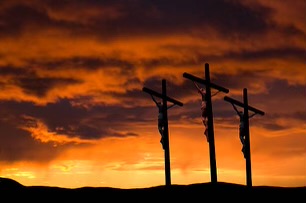
Jesus’s Crucifixion and Other Victims of Execution

Amy-Jill Levine’s recent book, Witness at the Cross, includes a chapter entitled “The Other Victims.” It is the account of Jesus’s interaction with the two anonymous men crucified with him. Dr. Levine aptly suggests that the inclusion by the Gospel writers of these two condemned men forces us to consider those awaiting execution in today’s prisons.

Over my years as a pastor and a bishop, I have spent many hours sitting with men condemned to be executed. Unlike the men in the Gospels, the ones I have visited have names. I have known some of their families. I listened to the anguished cries of a mother who watched her son executed by the state. She loved her son no less than the mother of the person he had murdered. In the name of “justice for the victim,” the state created additional victims and added to the culture of violence that plagues our world.

South Carolina is set to resume executions later this month. Since the state has had difficulty obtaining the lethal drugs needed to put Richard Moore to death, he must choose between the electric chair and the firing squad. Below is a letter I have sent to the governor requesting that he stop this barbaric action.

May Jesus’s attentiveness to the two other victims of state-sponsored execution on that fateful day two thousand years ago cause us to remember the approximately 2500 persons awaiting execution in our prisons today. From my understanding of the Incarnation, their execution will be a repeat of Jesus’s crucifixion!

It was for the two “bandits,” those participating in the execution, and us that Jesus prayed: “Father, forgive them, for they don’t know what they are doing” (Luke 23:34 CEB).

The Honorable Henry McMaster
State House
1100 Gervais Street
Columbia, South Carolina 29201

Dear Governor McMaster:

               I wish to strongly urge you to stay the execution of Richard Moore, currently scheduled to take place April 29. While Mr. Moore’s crime is a grave tragedy for which accountability is appropriate, it does not reach the level of premeditation and heinousness for which the death penalty is intended. From the news reports and court records, he entered the convenient store unarmed and his offense was fueled by drug addiction; therefore, the resulting murder was not premediated and took place in a struggle over a weapon.

               During this Holy Week for Christians, we relive the state sponsored execution of Jesus the Christ. As a retired United Methodist bishop, pastor, and seminary professor, I strongly support my denomination’s opposition to the death penalty. No evidence exists that executions are a deterrent to crime, and death inflicted by the state only adds to the culture of violence that permeates our society. Having visited persons on death row over more than fifty years of Christian ministry, I can testify that it only adds to the number of victims of violence as the families and friends of those executed are victimized by the state.

 I hope that before you make your decision whether to stop this barbaric act that you will exercise courage and visit with Mr. Moore and his family. As Jesus was attentive in his dying hours to the two men executed with him and offered forgiveness and assurance, I hope you will be attentive to Mr. Moore as a fellow human being, made in the divine image and redeemed in Jesus Christ. As one who has publicly declared as being “pro-life,” please be consistently pro-life and respect Mr. Moore’s right to life.

               Please be assured of my prayers as you discern the fate of Mr. Moore. May you bear witness to the justice and compassion as made known in Jesus the Christ, whom you and I seek to follow and serve.

Prayerfully yours,

Kenneth L. Carder

A Helpless Baby as Savior?

When did Jesus become the Savior?

It’s no idle question reserved for abstract thinking by academic theologians or reflective pastors. Was the vulnerable, helpless baby Jesus the Savior of the world or only the potential, future Savior?

Much of Christendom limits Jesus’s saving acts to the three years of his public ministry, with the decisive actions taking place the last week or even his three hours on the cross.

Only Matthew and Luke make direct reference to Jesus’s birth, though John describes the Incarnation in philosophical language (John 1:1-14). Other New Testament writers place the emphasis on his teachings, death, and resurrection as indicators of his identity as “Savior.”

Does that mean Jesus became Savior at his baptism and not at his birth?

Some in the early church believed that Jesus was “adopted” as the Son of God at his baptism, or crucifixion, or resurrection. His birth and early life were mere prelude or preparation for becoming the Savior.

“Adoptionism,” however, was declared a heresy by the Synod of Antioch and the first Council of Nicea in 325 AD. But the notion of Jesus’s birth and obscure years as being inconsequential to his role as Savior remains prominent in today’s understanding and practice of Incarnation.

At the core of the meaning of Incarnation, however, is that the sovereign, infinite God of all Creation became flesh in a helpless baby, born among the homeless of an unmarried teenage peasant girl in a faraway corner of the earth. He spent the first two years of his life as an immigrant. He grew up in a working-class family in a backwoods town, without any notoriety, doing nothing newsworthy or particularly noticeable.

Jesus was no less the Son of God as he nursed at Mary’s breast than when he was hanging on a cross. He was the Savior while having his diaper changed AND while feeding the multitudes and healing the sick. He was Emmanuel, God with us, while learning the Torah in the Nazareth synagogue as when he was teaching the disciples on the hillside. He was the Word-made-flesh as he worked with his hands in the carpenter’s shop as surely as when his hands were nailed to a tree on Golgotha.

The Incarnation of God in Jesus of Nazareth is more than a story of how God came in human flesh two thousand years ago. It is a description of how God comes NOW. God continues to come in vulnerability, powerlessness, poverty, dependency, and obscurity. And it is through vulnerability, weakness, powerlessness, and obscurity that Christ SAVES us.

Another name for the God who became human is LOVE, and love is a relationship of giving and receiving. Another way to describe it is as a dance. Dancing involves both leading and following. Sometimes love requires that we lead, even lift the other; at other times, we follow, and are lifted off by the other.

In the last years of my wife Linda’s life, she was totally dependent on my care and that of others. Her vulnerability, weakness, and powerlessness called forth our acts of love and devotion. Through her vulnerability, the “fruits of the Spirit” (Galatians 5:22-23) grew in those of us who loved her: love, joy, peace, longsuffering, kindness, goodness, faithfulness, gentleness, self-control.

Jesus the Christ still saves us through the vulnerable, weak, powerless, and dependent. Our most transformative celebration of Christmas is to meet him in those he called “the least of these”–the hungry, the naked, the homeless, the imprisoned, the sick, the grieving (Matthew 25:31-46).

Celebrating Love Connections Across Generations

One of my previous blogs consisted of reflections on entering my eighties. The dominating theme was that time is running out for me. Capacities and experiences are diminishing rather than expanding. More family members and close friends are dying than are being born. I am more focused on endings than beginnings.

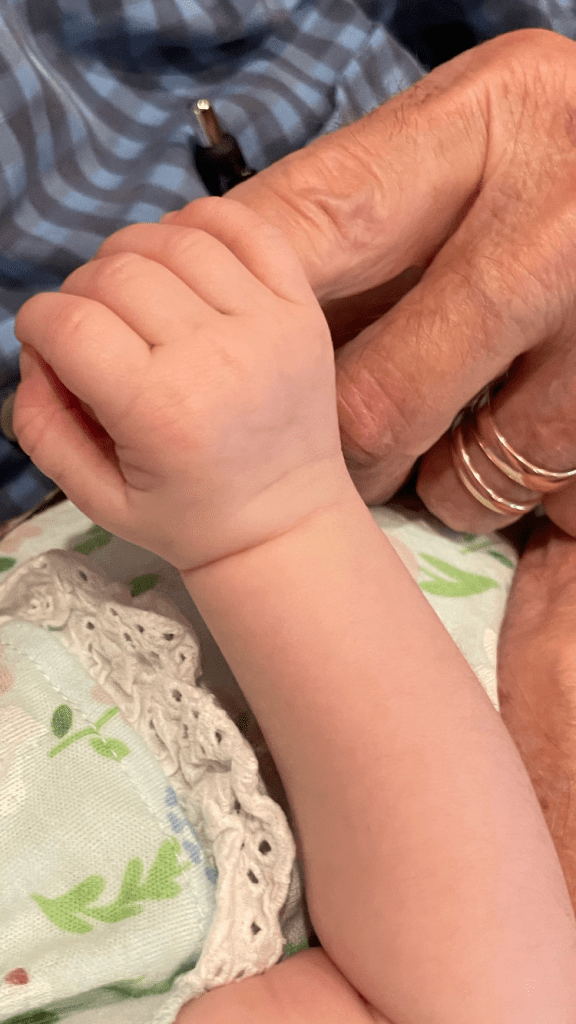
Then on March 20, my granddaughter, Katelyn Nash Aiken, gave birth to Vera Faye! Suddenly, life expanded rather than contracted. Coincidently, she was born on the first day of Spring as the earth was bursting with new life and beauty.

One look into Vera Faye’s beautiful, innocent eyes, and my heart leapt with joy. Here was pure, spontaneous love connecting across generations. It was a holy moment!

Her sparkling eyes and spirited smile brought instant joy. I felt the sanctity of pure love and the hope of new beginnings.

Such is the rhythm of creation. Such is the cycle of life. Birth and old age are part of the same tapestry of life. Being born and dying are built into the structure of everything, human and nonhuman.

There is continuity between beginnings and endings, birth and death. In one sense, nothing ever totally dies. All life is interrelated and in a constant process of changing. Biologically, we are all a collection of recycled atoms!

But we are more than clusters of cells and atoms. We are interconnected stories and part of a God’s Story of creation, liberation, restoration, incarnation, and transformation.

At the heart of life’s story is love, which is the power that creates us, connects us with one another and the creation, and ever seeks to unite us and enable us to flourish as God’s beloved children.

Sixty years ago tomorrow, June 30, Linda and I entered the covenant of marriage. I’m sorry that she did not live to know her great granddaughter. I can only imagine her ecstatic joy given the chance to hold this new member of our family. I will still celebrate our life together which now lives on in Vera Faye.

Vera not only carries Linda’s genes; she bears her middle name, Faye!

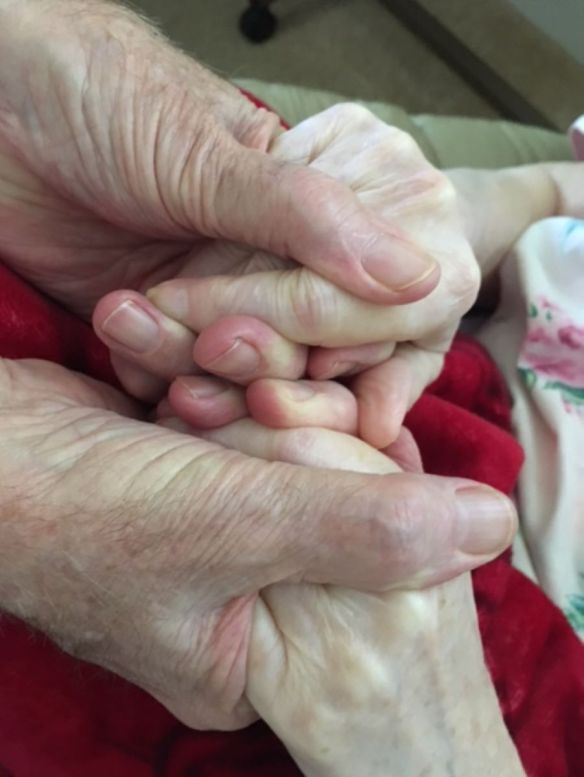
With Vera Faye’s instinctive grasp of my finger, I feel connected to one whose hand I can hold no longer but whose love continues to give life and hope.

Pentecost Happened Again

I experienced Pentecost in the most surprising place. It was four years ago, June 4, 2017.

Approximately twenty-five residents in varying stages of Alzheimer’s and other forms of dementia, plus six or eight volunteers, gathered for worship at Bethany, the memory-care facility at the Heritage at Lowman in Chapin, South Carolina.

Below is a slightly revised blog I shared following that service. I share it once more in hopes that we will all experience Pentecost again!

“How do we tell someone who has lost language comprehension that we love her?” I asked the worshippers at Bethany, the memory-care facility where my wife, Linda, was a resident for eighteen months. Beside me stood a resident whose speech has been reduced to incoherent babbling. She looked into my eyes as though longing to speak.

“Hug her,” came a response from a resident who struggles with hallucinations as well as lost and distorted memories. I put my arm around her and she embraced me in return.

Looking into her sad eyes and calling her by name, I said, “I love you!”

Suddenly, the sadness in her eyes turned to a sparkle. With a faint smile, she said plainly for all to hear, “I love you!” Babbling turned to the language of love.

It was Pentecost Sunday! We had been singing such hymns as “O for a Thousand Tongues to Sing,” “Kum bah Yah,”“Surely the Presence of the Lord is in this Place,” and “There’s a Sweet, Sweet Spirit in this Place.”

We heard the story of Pentecost in Acts 2 where people with different languages and cultures and traditions understood one another. “Tongues of fire” descended on diverse and multi-lingual people and God’s Spirit created a new community.

Bethany became a new community as the barriers once again crumbled!

Present among the residents were various religious traditions: American Baptist, Assemblies of God, Southern Baptist, Catholic, Episcopal, Holiness, Lutheran, Presbyterian, United Methodist, and Jewish. A few claim no religious affiliation. Some present in the service have forgotten God and no longer remember who Jesus is. Perhaps a few have never consciously known God.

All share a common characteristic: Alzheimer’s or another form of dementia.They are at various stages in their disease, but all are unable to live alone and care for themselves.

What made it possible for the people present at that Jewish festival to understand one another even though they spoke different languages?” I asked the worshippers.

They loved one another,” a resident called out. A conversation followed about how love enables us to understand and accept one another.

Other languages are present at Bethany. One couple speaks Portuguese. One’s native tongue is Spanish and another’s is Italian. A staff member speaks Swahili. A volunteer present for the service knows French and German.

“Let’s learn to say “I love you” in different languages,” I suggested. So, we tried to speak words of love in Portuguese, Spanish, Italian, French, German, and Swahili. With varying degrees of success, we tried to speak love in multiple languages.

It was during those exchanges that the resident whose language skills have been destroyed by her disease came and stood beside me. How do we say “I love you” to someone who can’t speak or understand words?

There followed a time of practicing love without words—hugs, handshakes, an open hand, a pat on the back, a warm smile. Other love languages were mentioned—helping, protecting, encouraging, feeding, bathing, just being with….

They got it! Beneath all our hyper-cognitive theological talk and creedal statements is the simple reality that God is LOVE. To love is to know God! Pentecost happens when people express the multiple languages of love!

The worshippers at Bethany are a microcosm of our world. They are black and white and brown. They are Christian, Jewish, and none of the above. Their behaviors are sometimes offensive and difficult. Intellectual abilities vary broadly. For some, the filters are gone, and they cross boundaries of affection and relationships. Some have been highly skilled professional people. Others have a background of common labor.

They are just like the rest of us! As I listen to the rancor in our society and churches and the talk about the United Methodist Church dividing as a denomination, I pray that we learn and practice the languages of love. One thing that binds us all together: We are God’s beloved children!

Within the embrace and “I love you” from the worshipper at Bethany on Pentecost Sunday was another voice! It was God’s Holy Spirit speaking the language of Greater Love, declaring to us all, “I know you by name. I have redeemed you! You are mine!”

We are surrounded by God’s ever-present love. Sharing that love in simple acts of kindness, compassion, and justice is our highest calling.

Two Landlords and Two Images of God

During my early childhood, my parents were tenant farmers and sharecroppers. We lived on three different farms in eastern Tennessee before I was nine years old. Two of the land owners made indelible, contrasting impressions on me. They helped to form my images of God and power.

One landowner scared me! I was only five years old when he held me over a rain barrel, threatening to drown me for playing on the roof of one of the farm buildings. “You’re gonna learn to respect me and my property,” he said angrily as he dangled me over the water.

“Respect” to him meant compliance, obedience, and “knowing our place.” We were among his possessions and considered to be subservient and dispensable. The housing provided for our family of six was a two-room shack with no insolation in the walls, no electricity, and no indoor plumbing.

I didn’t respect him. I was scared of him! Yes, I addressed him thereafter as “sir” and lived in constant fear that I would do something to displease him, but I secretly loathed him!

At that time, our family attended city-wide religious rallies, camp meetings, and revivals in which God was portrayed as a stern and sovereign judge who keeps records of all our wrongs. The end of the world was drawing near, and God would punish the wrongdoers and those who had not “accepted Jesus” by sending them to a burning hell for everlasting punishment. It felt as though I was being held over a burning inferno.

Though I didn’t consciously make the connection as a young child, the cruel landlord and God got connected in my mind. They both were all powerful, owned our livelihood, and expected, above all else, our respect, obedience, and acceptance of our place as “miserable sinners.”

That’s one image of God and power — authoritarian; dominating; controlling by intimidation, power-over; the superior enforcer; the judge. It’s often more subtle than what I experienced from that landlord, but it is no less dangerous and destructive.

Thankfully, we moved from that farm shortly after the incident with the rain barrel. The new landlord, Mr. Street, lived in a neighboring state. The house provided had four rooms and was much more comfortable for six people, though still no electricity and indoor plumbing.

The owner always let us know when he would be coming to visit. We eagerly waited for his arrival because he would bring us kids candy and my parents some useful gift. He would spend the day working in the field alongside us. (Yes, we children worked in the fields, too, hoeing rows of corn, cleaning out the barn, etc.) He was always kind, affirming of our work, and respectful of us!

We stayed on that farm for two years. The owner actually encouraged my dad to get his own small farm and offered to help make it possible. Tragically, he was killed in an accident on his farm in North Carolina. We were all saddened by the news. We respected him, trusted him, and enjoyed his presence.

Shortly after the kind landlord’s death, we moved again, this time to a small, hilly farm of 20 acres, which our parents bought on credit. Located within sight was McKinley Methodist Church. At age ten, I visited the church for the first time. Though it was seventy years ago, I remember it well. The teacher, Mrs. Mahoney, met me at the doorway and welcomed me with a warm hug.

The lesson that day was on the Good Shepherd. Mrs. Mahoney made a startling comment that began reshaping my image of God. She said, “God is like a good shepherd who searches for lost sheep and safely returns them home.” She not only told the story; she embodied it! 

God was not the severe landlord eager to punish and destroy the world. God was a tender shepherd who cared for the sheep, protected them, even willing to lay down his life for them. 

And God is more like the kind landlord who respected us, worked alongside us. He empowers rather than dominates, engenders love rather than fear, and encourages instead of terrorizes.

The contrasting images of God and power operate today in the worlds of business, education, politics, and religion. Maybe there is some of both landlords in all of us. But I know which one is most like the God we know in Jesus.