Following a Forgotten Jesus

IMG_20160623_111041354“We’re going to talk about Jesus,” I said to a resident at Bethany as I was rounding up people for Bible study. Her quizzical stare indicated that she didn’t understand the invitation.

I tried again, “Come with me. We’re going to tell stories of Jesus.“ The puzzled gaze intensified, signifying growing agitation with my persistence.  She retorted, “I don’t know what you are talking about! I don’t know any Jesus!”

Many residents in the memory care unit have forgotten Jesus. My wife, a trained Christian educator, who has spent her life in the church, doesn’t remember who Jesus is. Few if any of the residents can comprehend and verbalize basic tenets about Jesus—Son of God,  Lord and Savior, Incarnate Word, etc.

Can one who has forgotten or never consciously knew Jesus follow him? Can people with severe cognitive impairment be Jesus’ disciples?

If salvation requires intellectual and verbal acceptance of Jesus, where does that leave those who cannot comprehend or express who Jesus is?

We are all on a continuum when it comes to intellectual understanding and verbal skills. At what point are intellectual belief and verbal accent no longer prerequisites for following Jesus? Insisting on rational belief in and verbal confession of prescribed doctrinal propositions and creedal formulas eliminates the participants in my congregation at Bethany, including my wife.

But the residents are teaching me what it means to know and follow Jesus on a level deeper than the intellect and beyond words. They know Jesus even if they can’t remember his name or recite things about him.

My wife, Linda, only occasionally knows my name and remembers little of our fifty-five years of marriage. She doesn’t know me as her husband or the father of our daughters. Still, she knows me! She loves me!

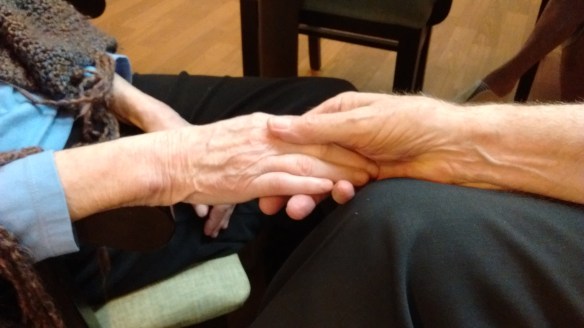
I sat quietly holding Linda’s hand. With a confused stare she asked, “Who are you?”  I replied, “I’m Kenneth, your husband.” The puzzled look intensified. “Kenneth? Who’s that?” she responded.

I interrupted the subsequent silence with an occasional “I love you!” She made no response. After a few minutes she said with tenderness and a twinkle in her eyes, “I have a wonderful man.”

“That’s great,” I remarked. “What’s his name?” was my follow up question. Bewilderment reappeared. She had no answer. “Is his name Kenneth?” I asked. “I don’t know. I can’t remember,” she said sorrowfully.

The one she experienced as a beloved person was holding her hand! Yet, she didn’t know my name or remember any facts about me or our life together. I knew, however, that she was expressing love for her forgotten husband!

Phillips Brooks and Helen Keller were friends. Several stories exist about their friendship. One incident has been shared in various versions. It seems that the eloquent preacher once described to the young Helen who Jesus is. As she “listened’ by placing her fingers on his lips, she became increasingly excited as the story of Jesus unfolded. Finally, she responded, “I knew him! I knew him! I didn’t know his name!”

In our hyper-cognitive and word-saturated world, we need to be reminded that God isn’t confined within the margins of our thoughts and language. Our intellectual formulations and affirmations about Jesus are important. Knowledge of the Jesus of the Gospels and the Creeds is significant. And verbal witness is part of Christian discipleship.

But those who have forgotten Jesus (or perhaps never cognitively knew him) can still love and follow Jesus!

Jesus shifted the margins when he declared, “Not everyone who says to me ‘Lord, Lord’ will enter the kingdom; but the one who does the will of my Father in heaven” (Matthew 7:21).

The woman who protested, “I don’t know any Jesus,” attended the Bible study session. As I was sharing the story of Jesus healing the woman bent over (Luke 13:10-17), the resident who had forgotten Jesus spontaneously began to sing, “Jesus Loves Me.”  She may have forgotten Jesus, but Jesus hasn’t forgotten her! And, she follows and loves a Jesus her mind no longer grasps!


Cognition can be an Idol

Living with and ministering among people with dementia is shifting my priorities and way of viewing the Christian faith. I am being confronted with my own idolatry.  I think I may have made an idol of cognition, thinking straight, and being intellectually competent.

Knowledge has always been a priority for me! Education became important very early. I’m not sure why. My parents only went through the sixth and eighth grades. The only book we had in our home was the Bible. But somehow “knowing” became important to me.  I suspect it was partly compensation for feelings of inferiority born of economic poverty.

I never considered myself to be smart and those intimidating standardized tests varied that I’m not “intellectually gifted.” But I worked hard, made good grades, and got lots of affirmation from teachers and others. Being intellectually proficient has been and continues to be highly valued. I genuinely want to love God with my mind.

I’ve spent a lifetime clarifying my beliefs and  helping others make intellectual sense of Christian doctrines. I’ve written books and articles on the importance of right beliefs. I have taught and preached those doctrines as a pastor and seminary professor. Beliefs and intellect do matter!

But the margins of my thinking are shifting! When Linda was diagnosed with Frontotemperal Dementia (FTD) in 2009, I was deeply immersed in the hyper-intellectual environment of Duke Divinity School. I spent my days teaching and writing. I graded students on their intellectual comprehension and integration and their oral and written communication skills. I was in intellectual heaven!

What a contrast to my current context! Now I am immersed in a different world.  While continuing to teach part time in seminary and the church, my daily life is among people whose intellectual comprehension and communication abilities are being stripped away by disease. Abstract thinking has ceased. Reading is nonexistent. Memories have vanished and only the present is real.  Most words have been deleted from their lexicon and verbal expressions are garbled and disconnected at best.

Many of those with whom I relate no longer know their families and some have forgotten their own names. Several don’t recognize themselves in the mirror. None of my congregation at Bethany can claim to know or explain such orthodox theological affirmations as the Trinity, Incarnation, Justification, Salvation, Atonement, authority of Scripture, etc. Many have forgotten who God is!

Yet, I have never been among people who seem closer to God and more faithful in their discipleship than those who live at Bethany, the memory care facility where my beloved Linda now resides.  I remind them regularly that they are in the home of Mary and Martha where Jesus felt most at home. I suspect Jesus feels more at home at this Bethany than in many churches.

Dementia shifts the margins of orthodoxy from the intellect to the heart, from knowing to being. Neuro-cognitive impairment provides a different lens through which to view such core doctrines as Creation, Incarnation, Imago Dei, Salvation, Discipleship, Vocation, etc.

What does it mean to know God? What does it mean to “accept Jesus as your Lord and Savior” when the person doesn’t know who Jesus is? Can people who are unable to comprehend and/or recite the orthodox creeds be disciples, full members of the church?  Do people with dementia have a calling, a vocation?

Where do people with dementia fit into the mission statement of The United Methodist Church: “make disciples of Jesus Christ for the transformation of the world”?  What is “right” and “wrong” behavior when the ability to make decisions has been lost? What would the local church look like if people with dementia really belonged?

These are among the questions I am raising as my understanding is shifting outside the margins of the abstract thinking. The people at Bethany know God, Jesus, and Church in ways that transcend cognition.

We have made cognition an idol if we assume that salvation is the product of our thinking. Some theologians have identified reason as “the image of God”, buying into Rene Descartes’ dictum “I think therefore I am.” That’s idolatry! That’s just plain wrong! The notion contributes to the dehumanizing and marginalizing of people with cognitive diseases.

At Bethany, the issues that occupy the contemporary church have little, if any, relevance. Arguments over who is orthodox and who isn’t, the definition of marriage, and which religion is right aren’t on their experiential radar. Those are abstractions, outside the margins of their existence!

What’s real are Love, Belonging, Dignity, Safety, Peace, Connection, and Presence that transcend the margins of intellect and language. The cognitively impaired know God, though they may no longer know about God!

The cognitively impaired are now my primary teachers! They are teaching me things I’ve not learned in books or from the intellectually astute. If we will enter their world, they just might save the church from its idolatrous notion that we are saved by our intellectually constructed doctrines and abstractions! We really are saved by GRACE!


Shifting the Margins

Throughout my more than half century of ordained ministry, I have felt called to ministry and presence among “the marginalized.” The imprisoned, the poor, and the hidden people in our communities have been critical to my life and ministry as a pastor, bishop, and seminary professor.

A significant shift in my scope of ministry took place six years ago. My wife and partner in ministry, Linda, was diagnosed with Frontotemperal Dementia, one of the neuro-cognitive disorders that fall under the umbrella we regrettably label dementia!

Since that dismal rainy day in November 2009 when we first heard the dreaded word dementia, my world and vocation have shifted. Losses have multiplied and the boundaries of engagement have significantly narrowed. I moved from bishop and professor to caregiver! Rather than the “world is my parish,” my family became my world!

The global became very local! Major concerns dominating the denomination and academia receded to the margins of my preoccupation. My daily relationships shifted from the hyper-cognitive and hyper-productive to the cognitively impaired and productively diminished! Life became a series of losses, a receding circle of relationships, and a restricted sphere of engagements and influence.

But being with people who live within the margins of the present moment, whose abstract thinking has disappeared, whose language is garbled, and who may not know their own names shifts the margins of one’s thinking about God, about life, about the church and its mission, about what really matters.

The motivation and name chosen for this blog is inspired by John Swinton, one of today’s premiere pastoral theologians. His book, Dementia: Living in the Memories of God, has reframed the way I view the margins and those affected by dementia. His book has become a theological companion as I accompany my beloved Linda on our mutual journey.  He provides a theological alternative to the dominant medical lens which views people with dementia in terms of their symptoms rather than their stories! And, he also helped me redefine the meaning of “marginalized.”

Swinton’s work reaches far beyond issues related to neuro-cognitive disorders. His theological perspective emerges from his experiences as a psychiatric nurse, hospital chaplain, and renowned academic scholar. He does theology through the lens of those whom society pushes to the margins but whom God claims as prime recipients and means of Divine Grace. Swinton writes:

 It is certainly the case that Jesus sat with the marginalized and it is also true that he offered them friendship, acceptance and a valued place within his coming Kingdom. However, it is not quite the case that Jesus sat with the marginalized. He certainly sat with those whom religious society had excluded and rejected as unclean and unworthy of attention. However, in sitting with such people, Jesus, who was and is God, actually shifted the margins. By shifting the margins with the pushed aside at the center, the religious authorities became the marginalized! They didn’t realize that Jesus had moved the margins to a totally different place.[i]

Where God is preferentially present becomes the center of reality! The Bible clearly declares that God chooses the most vulnerable—“the least of these”—as special recipients and means of grace! Indeed, Jesus so closely identifies with the poor, the sick, and the imprisoned that what is done to them is done to him (Matthew 25:31-46).

Could it be that those of us who separate ourselves from the most vulnerable and despised are the marginalized and  away from the center of God’s present and coming reign of justice, compassion, generosity, and joy? I know that Linda and the residents in the memory care facility where she now lives are pushing me to shift the margins of my thinking and living!

My daughters and a few friends have encouraged me to share some of my reflections as Linda and I continue “our long goodbye.” I do so somewhat reluctantly, for I do not wish to be presumptuous or in any way unfairly exploit our personal journey. I share in the hope that we all will be open to how God in Christ shifts the margins!

Ponder these additional words from John Swinton:

. . . God was with a totally different group of people doing something quite different: offering friendship and acceptance and revealing the Kingdom in and through that friendship. Jesus offered no “technique” or “expertise.” He simply gifted time, presence, space, patience and friendship. He befriended the tax collectors and sinners; he befriended the prostitute, the stranger and the stigmatised. He offered relational space and time to people for whom the world (and religion) had no time. In and through his friendships, he gave people back their names. Indeed, he gave them new names: “I no longer call you servants; now I call you friends.”[ii]


[i] John W. Swinton, “Doing Small Things with Extraordinary Love: Congregational Care of People Experiencing Mental Health Problems”, ABC Religion and Ethics, October 2014.

[ii] Ibid.