
Linda no longer remembers Jesus’ crucifixion and resurrection. In fact, she has forgotten Jesus and God! Mention of Easter only elicits a blank stare. Talk of Resurrection adds to confusion, even frustration at what seems to her like meaningless chatter.
Dementia erases more than memories of events, people, and experiences. It deletes abstract concepts, including cherished doctrines. If being “Christian” or a disciple of Jesus means believing prescribed abstract doctrines, people with cognitive impairment are beyond discipleship and salvation.
Such persons, however, can teach us what it means to really know the reality behind cherished doctrines. Linda and the residents at Bethany are teaching me that “believing” is not the core of Christian discipleship. Discipleship is doing what God does, which is the deepest form of knowing.
Most residents at Bethany have forgotten the stories of the empty tomb. None of them can explain what the doctrines of Incarnation, Atonement, and Resurrection mean. The words and concepts have been expunged from their brains and vocabularies.
Yet, they know Incarnation, Atonement, and Resurrection better than many whose cognitive faculties remain intact. They experience the realities affirmed in the doctrinal formulations, and they can be means by which we learn what doctrines really mean in our own experience.
I’m learning that Resurrection is more about life in this world than life after death. It is experiencing moments of Resurrection joy, love, beauty, truth, and goodness. Here are some Resurrection moments I have recently known:
- A momentary connection between Linda and Michael, our grandson, which elicited a winsome smile and twinkle in the eyes from both
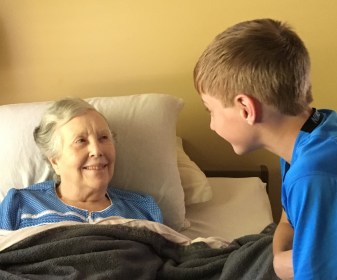
- An unexpected reach for my hand as I sat silently beside Linda

- A woman with disabilities who insisted on carrying the cross as we journeyed across the retirement community for “Stations of the Cross”
- A loud response to the declaration in worship at Bethany, “He is risen!” Residents, including some who seldom speak, replied,
“He is risen indeed!”
- A blind resident with cognitive loss who immediately sang a rarely sung verse of “Jesus Loves Me”:
Jesus loves me! He who died,
Heaven’s gate to open wide;
He will wash away my sin,
Let His little child come in
And the rest of us joined in the chorus:
Yes, Jesus loves me!
Yes, Jesus loves me!
Yes, Jesus loves me!
The Bible tells me so.
- Looks of delight and sighs of awe and wonder as fresh flowers were placed on the altar at Bethany

- The calming voice and gentle touch of a caregiver as she affirmed Linda’s dignity while bathing and dressing her and Linda’s surprising “thank you!”
Incarnation, Atonement, Resurrection are inseparable experiences! It’s another way of saying that loving presence and personal connections (incarnation) create possibilities for moments or experiences of new life (resurrection); and reconciliation and glimmers of wholeness emerge (atonement/salvation).
It is those who are sensitive to resurrection moments amid the mundane experiences of daily living who know the real meaning of “He is risen! He is risen indeed!”
Those moments come even among sealed tombs, dark nights, and upper rooms filled with frightened disciples.


