A Journey Toward Reconcilation with LBGTQ+ Friends

Elaine Eberhart and I have been friends since the mid-1980s when we served together on the pastoral staff of First UMC in Oak Ridge, Tennessee. As a delegate to General Conference in 1984, I regrettably voted for the legislation that prohibited the ordination of “self-avowed practicing homosexuals.” A few years later, Elaine surrendered her ordination in an act of integrity and courage.

Elaine’s grace-formed life and faithful witness contributed to my conversion and growth as a person, a Christian disciple, pastor, bishop, and teacher. In 2018, I wrote a short blog on why I changed my mind. Though Elaine was not specifically named, she is prominently among those who contributed immeasurably to my changed perspective and commitment. The blog received more than seventy thousand views. You may access it here: https://shiftingmargins.com/2018/09/25/why-i-changed-my-mind-about-homosexuality-and-the-church.

I continue to repent of the harm inflicted on LBGTQ+ siblings by my complicity and failure of leadership. Elaine has graciously extended her forgiveness, and our friendship has deepened. Although she has had a marvelously productive ministry as a lay person in such institutions as Emory University, Mayo Clinic, and the University of Tennessee, I regret that her exceptional gifts as a United Methodist pastor went unutilized.

In June 2025, I was among those who shed tears of joy as Elaine’s clergy credentials were restored by the Holston Annual Conference. It was a momentous occasion, a visible sign and foretaste of God’s reign of justice, reconciliation, and transformation.

You are welcome to join us on December 9 by zoom as Elaine and I engage in conversation. On this webinar, we share our story in hopes that our journey might be helpful to others who seek to experience the reconciliation so desperately needed in our world and church.

This free webinar is for both laity and clergy and will be held December 9, 2025, from 2 pm to 3 pm. To receive the link for the webinar, please register here https://clergyeducation.com/events/2512carder/.

“Betrayed with a Kiss and a Sword”

Jesus asked the piercing question of the disciple-turned-conspirator: “Judas, is it with a kiss that you are betraying the Son of Man?” (Luke 22:48)

Why a kiss? Would not a slap or pointed finger or clinched fist be more appropriate means of betraying Jesus into the hands of his opponents? But, no! Judas betrayed with a sign of affection!

Upon closer reflection, however, Jesus’ question is appropriate for all who claim allegiance to him. We rarely, if ever, hear expressed outright hatred or denunciation of Jesus. Yet, we all betray!

Most often our betrayal takes the form of declared affection for Jesus. Here are a few ways we betray Jesus with a kiss:

  • Singing “O How I Love Jesus” while hating those who are different
  • Declaring “Jesus Is Lord” while prioritizing partisan politics above the common good
  • Claiming Jesus’ forgiveness but holding grudges and seeking vengeance
  • Affirming love for God while despising neighbors near and far
  • Singing “Jesus Loves the Little Children, All the Children of the World” while failing to provide all children with access to education, medical care, safety and love
  • Proclaiming “God is Love” with anger in our voices and hate in our actions
  • Assert that Jesus is ‘the way, truth, and life’ and refuse to obey his command to love one another as he loves us
  • Saying “Lord, Lord” and failing to do what he says, go where he goes, and welcome those whom he loves

Judas resides in all of us!  We, too, betray with a kiss!

But Judas wasn’t the only disloyal disciple present in the garden when Jesus was arrested. Luke tells us, “One of them struck the slave of the high priest and cut off his right ear”(22:50).

Jesus responded resolutely, “No more of this!”

The kiss and the sword have much in common as forms of betrayal. History is replete with efforts to violently defend Jesus.

The Crusades were fought in name of loyalty to Jesus. Scientists were burned at the stake under the guise of protecting religious doctrine. Preachers used the Bible to promote slavery! Klansmen terrorized and murdered with burning crosses and prayers of devotion to Jesus. The Bible has been used as a sword of discrimination against women.

Defending Jesus with physical, verbal, and emotional swords is a pervasive means of betrayal. Could these be subtle contemporary examples of betrayal with swords?

  • Using Scripture as a weapon for exclusion, hatred, and discrimination
  • Promoting hatred of Muslims, immigrants, gays, and others in the name of defending the Christian faith
  • Applauding the Sermon on the Mount while defending possession of assault weapons as a “God-given right”
  • Proclaiming God’s preferential presence in “the least of these” while advocating public policies that damage the poor, vulnerable, and powerless
  • Increasing spending for weapons of war while decreasing support for education, healthcare, housing, and food for the under resourced

But the final word in the Christian gospel isn’t betrayal! It’s forgiveness, reconciliation, and healing.

In Matthew’s account of Judas’ betrayal, Jesus calls him “friend.” Judas’ kiss may have been betrayal, but Jesus’ response was one of steadfast love.

After admonishing the disciples against violence, Jesus healed the victim. The final word was/is healing, not violence.

From the cross, Jesus spoke the ultimate response to all forms of betrayal: “Father, forgive them; for they do not know what they are doing” (Luke 23:34).

Whether betrayed with a kiss or a sword, Jesus forgives, reconciles, transforms.

Following a Forgotten Jesus

IMG_20160623_111041354“We’re going to talk about Jesus,” I said to a resident at Bethany as I was rounding up people for Bible study. Her quizzical stare indicated that she didn’t understand the invitation.

I tried again, “Come with me. We’re going to tell stories of Jesus.“ The puzzled gaze intensified, signifying growing agitation with my persistence.  She retorted, “I don’t know what you are talking about! I don’t know any Jesus!”

Many residents in the memory care unit have forgotten Jesus. My wife, a trained Christian educator, who has spent her life in the church, doesn’t remember who Jesus is. Few if any of the residents can comprehend and verbalize basic tenets about Jesus—Son of God,  Lord and Savior, Incarnate Word, etc.

Can one who has forgotten or never consciously knew Jesus follow him? Can people with severe cognitive impairment be Jesus’ disciples?

If salvation requires intellectual and verbal acceptance of Jesus, where does that leave those who cannot comprehend or express who Jesus is?

We are all on a continuum when it comes to intellectual understanding and verbal skills. At what point are intellectual belief and verbal accent no longer prerequisites for following Jesus? Insisting on rational belief in and verbal confession of prescribed doctrinal propositions and creedal formulas eliminates the participants in my congregation at Bethany, including my wife.

But the residents are teaching me what it means to know and follow Jesus on a level deeper than the intellect and beyond words. They know Jesus even if they can’t remember his name or recite things about him.

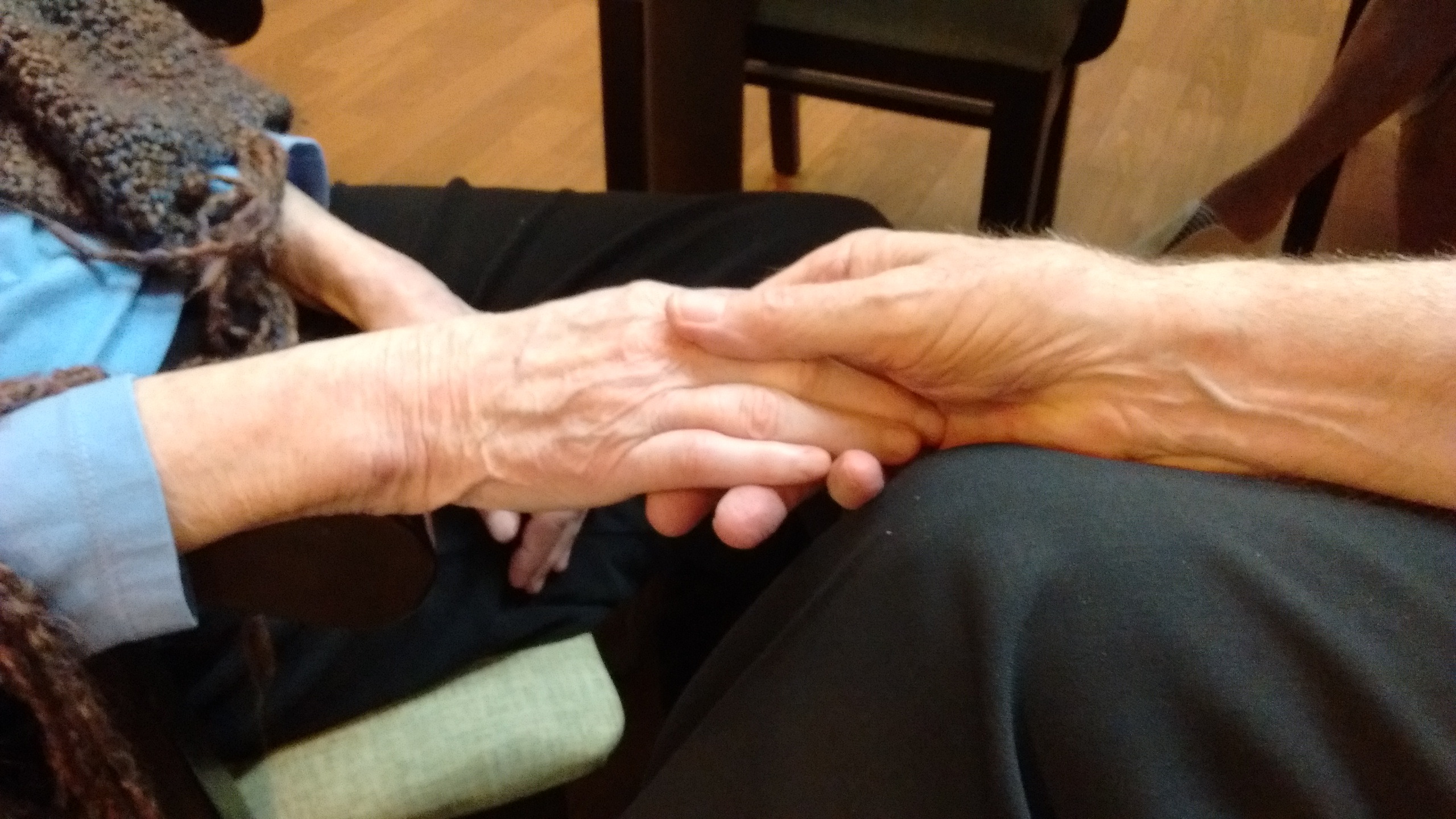
My wife, Linda, only occasionally knows my name and remembers little of our fifty-five years of marriage. She doesn’t know me as her husband or the father of our daughters. Still, she knows me! She loves me!

I sat quietly holding Linda’s hand. With a confused stare she asked, “Who are you?”  I replied, “I’m Kenneth, your husband.” The puzzled look intensified. “Kenneth? Who’s that?” she responded.

I interrupted the subsequent silence with an occasional “I love you!” She made no response. After a few minutes she said with tenderness and a twinkle in her eyes, “I have a wonderful man.”

“That’s great,” I remarked. “What’s his name?” was my follow up question. Bewilderment reappeared. She had no answer. “Is his name Kenneth?” I asked. “I don’t know. I can’t remember,” she said sorrowfully.

The one she experienced as a beloved person was holding her hand! Yet, she didn’t know my name or remember any facts about me or our life together. I knew, however, that she was expressing love for her forgotten husband!

Phillips Brooks and Helen Keller were friends. Several stories exist about their friendship. One incident has been shared in various versions. It seems that the eloquent preacher once described to the young Helen who Jesus is. As she “listened’ by placing her fingers on his lips, she became increasingly excited as the story of Jesus unfolded. Finally, she responded, “I knew him! I knew him! I didn’t know his name!”

In our hyper-cognitive and word-saturated world, we need to be reminded that God isn’t confined within the margins of our thoughts and language. Our intellectual formulations and affirmations about Jesus are important. Knowledge of the Jesus of the Gospels and the Creeds is significant. And verbal witness is part of Christian discipleship.

But those who have forgotten Jesus (or perhaps never cognitively knew him) can still love and follow Jesus!

Jesus shifted the margins when he declared, “Not everyone who says to me ‘Lord, Lord’ will enter the kingdom; but the one who does the will of my Father in heaven” (Matthew 7:21).

The woman who protested, “I don’t know any Jesus,” attended the Bible study session. As I was sharing the story of Jesus healing the woman bent over (Luke 13:10-17), the resident who had forgotten Jesus spontaneously began to sing, “Jesus Loves Me.”  She may have forgotten Jesus, but Jesus hasn’t forgotten her! And, she follows and loves a Jesus her mind no longer grasps!