The Sacrament of the Present Moment

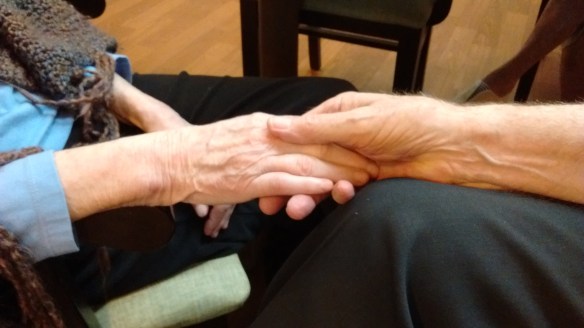
Catepillar1In response to a photo I posted which captured a moment of connection with Linda, a friend, Betty Cloyd, replied with the title of a book by the eighteenth century priest Jean-Pierre Caussade, The Sacrament of the Present Moment. The phrase captures the profound and transcendent nature of each moment.

Sacrament is often defined in the words of St. Augustine of Hippo as “an outward and visible sign of an inward and spiritual grace.” The English word comes from the Latin sacramentum, which means to make holy, or to consecrate. The term is also derived from the Greek New Testament word “mysterion,” or mystery.

So, how does the present moment rate as a sacrament? Each moment becomes a mysterious gift within which the holy and transcendent is present as grace, the loving power of God to create, renew, reconcile, and transform.

Pastoral theologian John Swinton contends that people with dementia do not lose their “sense” of time; they lose their “tense” of time. The real time is the present moment. Those who care for them must learn to be present in the moment.

Regrettably, I have never been as contemplative in my spiritual quest as I have wanted to be. But people with dementia, including my wife, are teaching me to be truly present in the moment. It’s hard work! I have to slow down, concentrate, pay attention to little movements and subtle expressions.

Celebrating the present moment is an art and craft. It is learned and honed with practice, requires disciplined attentiveness, mindfulness.  It is one of the gifts Linda is giving me now! She is teaching me the sacredness of the present moment.

We often speak of the ministry of presence. I frequently hear pastors, laity, and family members express hesitate about visiting people with dementia. “I don’t know what to say! They don’t know me when I arrive or remember when I leave. So, why visit?”

It is a devilish temptation which robs people with dementia, their pastors and family members of the sacrament of the present moment. From my experience as a caregiver and pastor, I am convinced that the feeling/experience of a momentary connection lasts far beyond the cognitive awareness.

People with dementia are hypersensitive to emotions. Linda senses moods of which I am unaware. I cannot hide my frustration or stress from her! It may be that as people with visual impairment become more sensitive to sounds, people with cognitive impairment develop added sensitivity to feelings/emotions/attitudes.

With very few exceptions, the one reality to which people with dementia respond is LOVE, even those in the severe stages. And you can’t fake it! They know if you care! They sense if you are afraid of them or uncomfortable with them. They sense if a caregiver really values them as persons or only relishes the paycheck or if a pastor or family member is only visiting out of a sense of duty.

What is the sacred within the present moment? It is LOVE! Love transforms the present moment into a sacrament!

A gentle touch, a clasp of the hand, a warm embrace, a silent presence, a  spontaneous smile, a compassionate act—these become sacraments, outward and visible signs of an inward and spiritual grace.

As we fill a moment with compassion we experience the sacrament of the present moment. After all, we experience God, the source of all love!

(Photo by Norma Smith Sessions)

Schism Is a Failure of Love and Leadership

Talk of schism in The United Methodist Church abounds, exposing an already distracted church. Contemplating split precisely when the world needs an embodied message of reconciliation is a transparent betrayal of the church’s nature and mission.

John Wesley in his sermon “On Schism” declares:

To separate ourselves from a body of living Christians, with whom we were before united, is a grievous breach of the law of love. It is the nature of love to unite us together; and the greater the love, the stricter the union. . . . It is only when our love grows cold, that we can think of separating from our brethren. And this is certainly the case with any who willingly separate from their Christian brethren. . . The pretences for separation may be innumerable, but want of love is always the real cause.[1]

As Christ’s followers, we are commanded to love one another with the same love with which Christ loves us. Love is precisely the criteria by which the world knows we are disciples: “By this everyone will know that you are my disciples, if you love one another”(John 13:15).

However we may rationalize schism as faithfulness to truth and orthodoxy, or as the cost of bold prophetic witness, the world correctly sees it as the failure to love. A church that cannot struggle together with conflicts over sexuality, interpretation of Scripture, and orthodoxy has little to say to a violently divided world.

The failure to love is also a negation of the church’s leadership. History is replete with examples of the church’s failure to provide leadership in times of polarization and division.

A historian of American religion, C. C. Goen, provides a relevant case study. His book Broken Churches, Broken Nation: Denominational Schisms and the Coming of the American Civil War chronicles denominational schisms as precursors to the violent breech in the nation.

Though he does not contend that the churches caused the split, Goen argues that the denominational divisions represented a tragic “failure of leadership.” The Methodists, Baptists, and Presbyterians opted for retreating into homogeneous ecclesial enclaves rather than engage in difficult conversations on slavery and human dignity. Attempts at persuasion gave way to legislative coercion. When legislation failed, division and violence became the attempted solutions.

Rather than leading the nation toward justice and reconciliation, the denominations simply mirrored society’s brokenness. By splitting into self-justifying enclaves of like-minded congregations, the denomination opted to mirror the brokenness in society.  The church, thereby, provided an ecclesial model and theological underpinning for a broken nation and subsequent civil war.

The United Methodist Church is once again positioned to provide leadership to a world dreadfully divided and retreating into dangerous ideological ghettos. Will we once again exhibit a failure of love and leadership?

I am finding a hopeful alternative in an unexpected place. I have the privilege of providing a pastoral presence with approximately forty people living with some form of dementia, their families, and staff who care for them. Those marginalized children of God embody reconciliation and oneness that transcends uniformity.

Every worship service is Pentecost at Bethany, the memory care facility. Although each participate is unique and the religious backgrounds include Protestant, Catholic, Jewish, and “none,” we gather as one community. Many have lost verbal abilities and comprehension. Theological and creedal abstractions elude them. Behaviors are unpredictable. Disruptions are accepted in stride.

It is not uncommon to hear a resident sing “Amazing Grace” in her native Portuguese or another in Spanish or Italian. A Jewish man joins in praying the Lord’s Prayer. People who can’t remember their own name recite Psalm 23 in unison. Some who have forgotten who Jesus sing “Jesus Loves Me” with gusto.

Much of the language is babble and incoherent. Yet, there is an understanding that transcends cognition. I asked, “How is it that you seem to understand one another?” A woman whose persistent petition during intercessory prayers is for world peace, responded: “We love one another. We communicate with the heart.”

That is leadership! That is love! Loving one another and communicating with the heart! That is the way forward for a denomination that claims as its mission “to make disciples of Jesus Christ for the transformation of the world.”


[1] Albert C. Outler, editor, The Works of John Wesley, Vol. 3(Nashville: Abingdon Press, 1986), p. 64.

“Why Don’t You Get on with Your Life?”

“Why don’t you get on with your life?”That was the question raised to a friend whose wife is in a memory care facility.

For six years, he has visited her daily between 1:00 and 3:00 p.m. Since the disease has taken her language, he mostly sits silently beside her, gently holding her hand. She responds with an occasional smile or a momentary twinkle in her eyes.

The casual observer assumes that she no longer knows her husband, rendering his visits meaningless. As I often hear from medical staff, family members, and friends, “They aren’t there anymore. She/he is already gone.”

If they are already gone, why continue to invest time and energy in relating to them?  Or as one daughter said about not visiting her mother, “She’s not the mother I’ve known. I want to remember her as she was.”

A pastor remarked, “They don’t recognize me when I visit or remember that I’ve been there. I have so many other things to do. They aren’t really there, so what purpose does a visit serve?”

Pat Robertson suggested in response to a caller on his television program that a husband can justifiably divorce his wife with dementia. His reasoning:  “. . . I hate Alzheimer’s. It is one of the most awful things because here is a loved one—this is the woman or man that you have loved for 20, 30, 40 years. And suddenly that person is gone. They’re gone. They are gone.“

Since the person with Alzheimer’s is “gone,” it seems permissible that “you get on with your life!”

The advice may be well intended.  Neurocognitive diseases do change people, stripping from them capacities to remember, communicate, and reason.  Personality changes are real and often dramatic. Difficult behaviors emerge.  Reciprocity vanishes or diminishes. Dependency escalates with ever-weighty demands on spouses and family.

Caregiving can be all consuming, with devastating physical and emotional consequences for the spouse.  Relentless grieving and pervasive sadness take their toll. Therefore, there is some value in suggesting that “you get on with your life.”

The advice, however, is based on a devastating myth:  Identity and worth lie in our capacity to think clearly, remember rightly, communicate plainly, and behave appropriately. It is the popular acceptance of Descartes’ dictum, “I think, therefore, I am.”

My friend responded succinctly and firmly to the suggestion that he get a life. He said simply, “This is my life!” He added that he enjoys spending time with his wife. Love is central to who he is. She may not always cognitively know him, but he knows who she has been and who she IS; and he loves her for all she has been AND for all she is! Love gives life, joy, connection to both!

Those of us who refuse to live by the myth know something very important: THEY ARE STILL THERE!  We are more than our thoughts or capacities or behaviors. We are distinct, beloved children of God, whose worth and identity are held permanently by God!

Those who take the time and energy to be attentive, to get inside the world of loved ones, to listen to the feelings behind the incoherent language, to really BE PRESENT know the person is still there!

Sometimes we see it in a faint twinkle in the eyes, or a characteristic gesture, or a fleeting smile, or a slight squeeze of the hand. When it happens, there emerges a profound joy which may last only a moment.  But the joy is real for both, and the residual effects endure longer than can be measured.

On the rare days when my friend does not arrive at the memory care facility at 1:00, his wife can be seen standing at the window looking out toward the parking lot. Mysteriously and inexplicably, she knows it’s time for her husband to come. She is STILL THERE! And he knows it!

“It is what it is!”

img_5388

“It is what it is! I’ve got it. I wish I didn’t have it, but I have to make the most of it!”

Those are the remarks of my neighbor and friend, Dale Sessions, who is in the middle stages of Alzheimer’s disease. He is among my mentors, teaching me about courage, discipleship, and ministry as he approaches his disease with characteristic courage, exuberant humor, and disarming authenticity.

Dale has seen the disease at its worst both as a professional and as a family member.  His ministry has included the pastorate as an American Baptist clergy and the chaplaincy in mental health facilities and addiction treatment centers.  Prior to retiring, he was the chaplain in a long term care facility where he provided pastoral care for elderly veterans, including those with dementia.

Dale is prophetically pastoral and pastorally prophetic.  He envisions a world of justice, compassion, reconciliation, and peace; and he has been an advocate for peace, civil rights, and economic justice. He has facilitated change in systems and individuals by helping others see new possibilities and to believe that change is possible, at both the personal and community levels.  He resists the notion of victimization and helplessness; and with compassion and humor he instills hope that things can change for the better.

His experience with Alzheimer’s has been painfully personal. Both his father and brother died from the disease after years of relentless loss and decline.  Following his father’s death and his brother’s diagnosis, Dale was acutely aware of his own risk. He thought and wrote a lot about the possibilities awaiting him.  But something deep within enabled him to accept the negative prospects, which he faced with “eyes wide open.”

Soon after symptoms began to appear, Dale courageously sought an evaluation.  Immediately upon receiving confirmation of the disease, he volunteered to be part of a clinical trial at Emory with the hope of helping others.  He willingly relinquished his driving privileges and began making plans for his diminished capacities. He and his lovingly supportive wife, Norma, moved into a retirement community.

Alzheimer’s disease is relentlessly stripping away Dale’s exceptional language and cognitive abilities. Once an avid reader and astute analyst of contemporary culture, he can no longer comprehend a simple lunch menu or remember the last news report. Once a gregarious extrovert who lit up every room he entered, Dale’s world and circle of friends have narrowed. Silence is becoming more prevalent than his jolly laughter. The twinkle in his blue eyes is giving way to that recognizable detached glare.

Dale’s dealing with his Alzheimer’s is an example of what Marilynne Robinson calls “prevenient courage.” In Gilead, she writes,

“Theologians talk about a prevenient grace that precedes grace itself and allows us to accept it. I think there must also be a prevenient courage that allows us to be brave – that is, to acknowledge that there is more beauty than our eyes can bear, that precious things have been put into our hands and to do nothing to honor them is to do great harm. And therefore, this courage allows us… to make ourselves useful. It allows us to be generous, which is another way of saying exactly the same thing.” (245-246)

What accounts for Dale’s courage in confronting his disease? What were the experiences which contributed to this “prevenient courage”?  We can assume that those whom Dale served and his experience with his father and brother helped to shape his own response. He saw those whom he served as his friends, teachers, and colleagues in ministry.

Each of us can increase our awareness of and response to those around us who serve as our teachers, preparing us for whatever lies ahead. We can affirm “It is what it is!” with courage because we are held in community. People with dementia, people with mental illness, people struggling with addictions and others whom we might think have little to offer, are part of that community!

I share Dale’s story of courage to emphasize that people with dementia have gifts to share.  They minister by their presence. I wish everyone could have witnessed the power of his presence as he and I shared Communion with residents, staff, and family members at Bethany memory care facility. And, you should have seen the courage and grace in Dale’s tear-filled eyes as he served me Communion!

“It is what it is” and it is GRACE!

[I did an interview with Dale a few months ago when his language skills were more intact. I wanted others to hear Dale’s comments and to witness his courage and discipleship. You can access the eight minute interview on YouTube: https://youtu.be/Sff-fgZ8Des.]

“I Don’t Want to be a Burden”

“I don’t want to be a burden to my family. My kids have their own lives and shouldn’t have to be burdened with me,” said the mother in the early stages of Alzheimer’s disease.

I’ve made the statement myself and heard it from Linda when she was diagnosed with Frontotemperal Dementia.  We moved near our daughters for support in our declining years; but I still struggle with the balance between support and being a burden.

“Being a burden” is high on the list of fears of older adults.  The fear is rooted in the dangerous myths of individualism and self-sufficiency.

Warren Kinghorn, a psychiatrist and theologian at Duke University, lists five societal mistakes harmful to people with dementia. One is the notion,”It’s good not to be a burden (and not to need others).”

“The remarkable thing about human life,” writes Dr. Kinghorn, “is not that humans are frequently a burden to each other, but that bearing each other’s burdens is simply what humans do. It is care and relationship, not isolation and individualism, which are normative to human life.”[i]

We come into the world as dependent creatures and the interdependency only grows more complex and multi-layered as we mature.

Therefore, bearing burdens is integral to being human! I am increasingly convinced that we have an innate need to nurture and care for others.  Bearing burdens is in our DNA! I see it daily in my relationships with residents in the memory care unit.  Many people with dementia are hypersensitive to feelings as expressed in voice tone and non-verbal communication. Many seem to intuitively know when someone is angry, frustrated, lonely, or not feeling well.

We recently found Linda in another resident’s room. She was bent over the sleeping man, gently stroking his shoulders. She was overheard saying, “I’m sorry. If you’re having a problem, I will get them to help.  It’s okay if you’re just sleeping.  I just want to make sure you’re okay. I love you.” John, about whom she was concerned, is in the severe stage of his disease and tends to be isolated from other residents.  Linda seems to sense his need for support and she has a need to provide support!

This dynamic of bearing burdens and being burdens is rooted in the very nature and mission of God.  God declared to Moses, “I have observed the misery of my people who are in Egypt; I have heard their cry on account of their taskmasters. Indeed, I know their sufferings, and I have come down to deliver them. . .” (Exodus 3:7-8). God is a burden-bearing God.

In Jesus the Christ, God “pitched tent” among us and shouldered our burdens all the way to and through the Cross and sets us free to bear one another’s burdens.

Bearing burdens is part of what it means to the body of Christ: “Bear one another’s burdens, and in this way . . . you fulfill the law of Christ” (Galatians 6:2, NRSV). Bearing one another’s burdens is an opportunity to share in Christ’s self-emptying love.  Furthermore, in bearing one another’s burdens we meet the Risen Christ and grow into his likeness.

Bearing burdens is not a burden when shared in covenant community of love. Burden-sharing is part of the Christian community’s identity and mission.

I often enter the memory care unit feeling weighted down with the burden of loss and grief, assuming that I am there to lift the burdens of those trapped in confusion and vanished memories.  When I take  time to enter the world of those who bear the burden of the disease, be they staff, residents, or family members, a mysterious connection occurs. It may be a faint smile, or sudden sparkle in the eye, or an unexpected hug, or a jolly laugh, or a friendly “hello.”  But in that simple moment of joy, those whom society considers as burdens lift my burdens.

Together we meet the One who extends this invitation: “Come to me, all you that are weary and carry heavy burdens, and I will give you rest. Take my yoke upon you, and learn from me; for I am gentle and humble in heart, and you will find rest for your souls. For my yoke is easy, and my burden is light” (Matthew 11:28-30 NRSV).

 [i]Warren A.. Kinghorn, “I Am Still With You”: Dementia and the Christian Wayfarer,” Journal of Religion, Spirituality & Aging, 00:1-20, 2015.


Following a Forgotten Jesus

IMG_20160623_111041354“We’re going to talk about Jesus,” I said to a resident at Bethany as I was rounding up people for Bible study. Her quizzical stare indicated that she didn’t understand the invitation.

I tried again, “Come with me. We’re going to tell stories of Jesus.“ The puzzled gaze intensified, signifying growing agitation with my persistence.  She retorted, “I don’t know what you are talking about! I don’t know any Jesus!”

Many residents in the memory care unit have forgotten Jesus. My wife, a trained Christian educator, who has spent her life in the church, doesn’t remember who Jesus is. Few if any of the residents can comprehend and verbalize basic tenets about Jesus—Son of God,  Lord and Savior, Incarnate Word, etc.

Can one who has forgotten or never consciously knew Jesus follow him? Can people with severe cognitive impairment be Jesus’ disciples?

If salvation requires intellectual and verbal acceptance of Jesus, where does that leave those who cannot comprehend or express who Jesus is?

We are all on a continuum when it comes to intellectual understanding and verbal skills. At what point are intellectual belief and verbal accent no longer prerequisites for following Jesus? Insisting on rational belief in and verbal confession of prescribed doctrinal propositions and creedal formulas eliminates the participants in my congregation at Bethany, including my wife.

But the residents are teaching me what it means to know and follow Jesus on a level deeper than the intellect and beyond words. They know Jesus even if they can’t remember his name or recite things about him.

My wife, Linda, only occasionally knows my name and remembers little of our fifty-five years of marriage. She doesn’t know me as her husband or the father of our daughters. Still, she knows me! She loves me!

I sat quietly holding Linda’s hand. With a confused stare she asked, “Who are you?”  I replied, “I’m Kenneth, your husband.” The puzzled look intensified. “Kenneth? Who’s that?” she responded.

I interrupted the subsequent silence with an occasional “I love you!” She made no response. After a few minutes she said with tenderness and a twinkle in her eyes, “I have a wonderful man.”

“That’s great,” I remarked. “What’s his name?” was my follow up question. Bewilderment reappeared. She had no answer. “Is his name Kenneth?” I asked. “I don’t know. I can’t remember,” she said sorrowfully.

The one she experienced as a beloved person was holding her hand! Yet, she didn’t know my name or remember any facts about me or our life together. I knew, however, that she was expressing love for her forgotten husband!

Phillips Brooks and Helen Keller were friends. Several stories exist about their friendship. One incident has been shared in various versions. It seems that the eloquent preacher once described to the young Helen who Jesus is. As she “listened’ by placing her fingers on his lips, she became increasingly excited as the story of Jesus unfolded. Finally, she responded, “I knew him! I knew him! I didn’t know his name!”

In our hyper-cognitive and word-saturated world, we need to be reminded that God isn’t confined within the margins of our thoughts and language. Our intellectual formulations and affirmations about Jesus are important. Knowledge of the Jesus of the Gospels and the Creeds is significant. And verbal witness is part of Christian discipleship.

But those who have forgotten Jesus (or perhaps never cognitively knew him) can still love and follow Jesus!

Jesus shifted the margins when he declared, “Not everyone who says to me ‘Lord, Lord’ will enter the kingdom; but the one who does the will of my Father in heaven” (Matthew 7:21).

The woman who protested, “I don’t know any Jesus,” attended the Bible study session. As I was sharing the story of Jesus healing the woman bent over (Luke 13:10-17), the resident who had forgotten Jesus spontaneously began to sing, “Jesus Loves Me.”  She may have forgotten Jesus, but Jesus hasn’t forgotten her! And, she follows and loves a Jesus her mind no longer grasps!


We Are Stories, Not Symptoms

The physician’s assistant (PA) was sharing the results of an evaluation of Linda. We were seated at a table, with Linda beside me and the PA across the table.

Looking at me, the PA said coldly, “Mr. Carder, your wife is no longer the person she used to be.”

She went on to describe the symptoms of Linda’s dementia—lost memory, disorientation, confusion, agitation, inability to focus and solve problems, loss of language skills, etc.  All the while, her eyes were on me, as though Linda didn’t exist.

I noticed Linda’s growing agitation and restlessness–the glare in her eyes, the rigidity of her body, the scowl on her face.  I knew that look. The PA was about to learn something she missed in medical training.

Linda straightened in her chair, looked squarely at the PA. Slowly, firmly and deliberately, she said, “Talk– to– ME!”

Taking Linda by the hand and smiling proudly, I said to the stunned expert, “You just met Linda.”

I added, “She isn’t a disease or cluster of symptoms. She’s a person you don’t know. You only see her symptoms. I know her story.”

Regrettably, the PA reflects a prevalent lens through which people with dementia are viewed. They are seen as a medical diagnosis, a disease that robs them of identity. They’ve “lost their mind!” They aren’t fully human. They have impaired memories, so they have no identity. They can’t produce, so they have no value. They can’t reason and relate, so they don’t belong.

Here’s the point:  We are stories, not symptoms or categories or labels! People never fit neatly into the margins of any lens or label or category. Stories are always complex, multilayered, intertwined, and unfinished.  And, we don’t really know another until we know his/her story.

We try to force others within our narrow margins of perception, especially those not like us. Those outside the margins of our theology, politics, class, race, ethnicity, culture, or sexual orientation are treated as objects of our margin-justification efforts. We speak past them, about them, against them, around them, and down to them. We seldom speak to them and almost never listen to them, learn their stories.

I’m learning anew that every behavior has a story behind it. When Linda was first admitted to Bethany, she was awakened every night by another resident who kept coming into her room, turning on the light, adjusting her pillow, and speaking garbled words to her. It was frightening to Linda and disruptive to staff. The intruder’s behavior didn’t make sense. Or did it?

Mary (not her name) was a retired nurse! Her behavior now made perfectly good sense; she was working the night shift and Linda was one of her patients.

Shortly after Linda entered the memory care facility, I wrote a letter to the staff. In that letter, I shared some of her story and why she is important to me. I wanted them to see her as a person with a story worth knowing. Treatment of her changed. They came to see her as more than a category called “dementia.” They see beyond the symptoms; they see her as a person.

Here is the larger point: We don’t know another until we see him/her as part of God’s Story. God’s Story simply will not fit neatly into any of our categories-medical, religious, doctrinal, cultural, political, or otherwise!

Until we see others as part of God’s Story of Creation and Redemption, they will be but identified symptoms and labeled categories. As symptoms and categories, they can be pushed aside, devalued, scorned, defeated, and feared.

But they/we are participants in God’s unfolding Story of creation, liberation, reconciliation, restoration, and transformation. That’s our identity, our worth, our dignity, and our destiny.


Cognition can be an Idol

Living with and ministering among people with dementia is shifting my priorities and way of viewing the Christian faith. I am being confronted with my own idolatry.  I think I may have made an idol of cognition, thinking straight, and being intellectually competent.

Knowledge has always been a priority for me! Education became important very early. I’m not sure why. My parents only went through the sixth and eighth grades. The only book we had in our home was the Bible. But somehow “knowing” became important to me.  I suspect it was partly compensation for feelings of inferiority born of economic poverty.

I never considered myself to be smart and those intimidating standardized tests varied that I’m not “intellectually gifted.” But I worked hard, made good grades, and got lots of affirmation from teachers and others. Being intellectually proficient has been and continues to be highly valued. I genuinely want to love God with my mind.

I’ve spent a lifetime clarifying my beliefs and  helping others make intellectual sense of Christian doctrines. I’ve written books and articles on the importance of right beliefs. I have taught and preached those doctrines as a pastor and seminary professor. Beliefs and intellect do matter!

But the margins of my thinking are shifting! When Linda was diagnosed with Frontotemperal Dementia (FTD) in 2009, I was deeply immersed in the hyper-intellectual environment of Duke Divinity School. I spent my days teaching and writing. I graded students on their intellectual comprehension and integration and their oral and written communication skills. I was in intellectual heaven!

What a contrast to my current context! Now I am immersed in a different world.  While continuing to teach part time in seminary and the church, my daily life is among people whose intellectual comprehension and communication abilities are being stripped away by disease. Abstract thinking has ceased. Reading is nonexistent. Memories have vanished and only the present is real.  Most words have been deleted from their lexicon and verbal expressions are garbled and disconnected at best.

Many of those with whom I relate no longer know their families and some have forgotten their own names. Several don’t recognize themselves in the mirror. None of my congregation at Bethany can claim to know or explain such orthodox theological affirmations as the Trinity, Incarnation, Justification, Salvation, Atonement, authority of Scripture, etc. Many have forgotten who God is!

Yet, I have never been among people who seem closer to God and more faithful in their discipleship than those who live at Bethany, the memory care facility where my beloved Linda now resides.  I remind them regularly that they are in the home of Mary and Martha where Jesus felt most at home. I suspect Jesus feels more at home at this Bethany than in many churches.

Dementia shifts the margins of orthodoxy from the intellect to the heart, from knowing to being. Neuro-cognitive impairment provides a different lens through which to view such core doctrines as Creation, Incarnation, Imago Dei, Salvation, Discipleship, Vocation, etc.

What does it mean to know God? What does it mean to “accept Jesus as your Lord and Savior” when the person doesn’t know who Jesus is? Can people who are unable to comprehend and/or recite the orthodox creeds be disciples, full members of the church?  Do people with dementia have a calling, a vocation?

Where do people with dementia fit into the mission statement of The United Methodist Church: “make disciples of Jesus Christ for the transformation of the world”?  What is “right” and “wrong” behavior when the ability to make decisions has been lost? What would the local church look like if people with dementia really belonged?

These are among the questions I am raising as my understanding is shifting outside the margins of the abstract thinking. The people at Bethany know God, Jesus, and Church in ways that transcend cognition.

We have made cognition an idol if we assume that salvation is the product of our thinking. Some theologians have identified reason as “the image of God”, buying into Rene Descartes’ dictum “I think therefore I am.” That’s idolatry! That’s just plain wrong! The notion contributes to the dehumanizing and marginalizing of people with cognitive diseases.

At Bethany, the issues that occupy the contemporary church have little, if any, relevance. Arguments over who is orthodox and who isn’t, the definition of marriage, and which religion is right aren’t on their experiential radar. Those are abstractions, outside the margins of their existence!

What’s real are Love, Belonging, Dignity, Safety, Peace, Connection, and Presence that transcend the margins of intellect and language. The cognitively impaired know God, though they may no longer know about God!

The cognitively impaired are now my primary teachers! They are teaching me things I’ve not learned in books or from the intellectually astute. If we will enter their world, they just might save the church from its idolatrous notion that we are saved by our intellectually constructed doctrines and abstractions! We really are saved by GRACE!


Shifting the Margins

Throughout my more than half century of ordained ministry, I have felt called to ministry and presence among “the marginalized.” The imprisoned, the poor, and the hidden people in our communities have been critical to my life and ministry as a pastor, bishop, and seminary professor.

A significant shift in my scope of ministry took place six years ago. My wife and partner in ministry, Linda, was diagnosed with Frontotemperal Dementia, one of the neuro-cognitive disorders that fall under the umbrella we regrettably label dementia!

Since that dismal rainy day in November 2009 when we first heard the dreaded word dementia, my world and vocation have shifted. Losses have multiplied and the boundaries of engagement have significantly narrowed. I moved from bishop and professor to caregiver! Rather than the “world is my parish,” my family became my world!

The global became very local! Major concerns dominating the denomination and academia receded to the margins of my preoccupation. My daily relationships shifted from the hyper-cognitive and hyper-productive to the cognitively impaired and productively diminished! Life became a series of losses, a receding circle of relationships, and a restricted sphere of engagements and influence.

But being with people who live within the margins of the present moment, whose abstract thinking has disappeared, whose language is garbled, and who may not know their own names shifts the margins of one’s thinking about God, about life, about the church and its mission, about what really matters.

The motivation and name chosen for this blog is inspired by John Swinton, one of today’s premiere pastoral theologians. His book, Dementia: Living in the Memories of God, has reframed the way I view the margins and those affected by dementia. His book has become a theological companion as I accompany my beloved Linda on our mutual journey.  He provides a theological alternative to the dominant medical lens which views people with dementia in terms of their symptoms rather than their stories! And, he also helped me redefine the meaning of “marginalized.”

Swinton’s work reaches far beyond issues related to neuro-cognitive disorders. His theological perspective emerges from his experiences as a psychiatric nurse, hospital chaplain, and renowned academic scholar. He does theology through the lens of those whom society pushes to the margins but whom God claims as prime recipients and means of Divine Grace. Swinton writes:

 It is certainly the case that Jesus sat with the marginalized and it is also true that he offered them friendship, acceptance and a valued place within his coming Kingdom. However, it is not quite the case that Jesus sat with the marginalized. He certainly sat with those whom religious society had excluded and rejected as unclean and unworthy of attention. However, in sitting with such people, Jesus, who was and is God, actually shifted the margins. By shifting the margins with the pushed aside at the center, the religious authorities became the marginalized! They didn’t realize that Jesus had moved the margins to a totally different place.[i]

Where God is preferentially present becomes the center of reality! The Bible clearly declares that God chooses the most vulnerable—“the least of these”—as special recipients and means of grace! Indeed, Jesus so closely identifies with the poor, the sick, and the imprisoned that what is done to them is done to him (Matthew 25:31-46).

Could it be that those of us who separate ourselves from the most vulnerable and despised are the marginalized and  away from the center of God’s present and coming reign of justice, compassion, generosity, and joy? I know that Linda and the residents in the memory care facility where she now lives are pushing me to shift the margins of my thinking and living!

My daughters and a few friends have encouraged me to share some of my reflections as Linda and I continue “our long goodbye.” I do so somewhat reluctantly, for I do not wish to be presumptuous or in any way unfairly exploit our personal journey. I share in the hope that we all will be open to how God in Christ shifts the margins!

Ponder these additional words from John Swinton:

. . . God was with a totally different group of people doing something quite different: offering friendship and acceptance and revealing the Kingdom in and through that friendship. Jesus offered no “technique” or “expertise.” He simply gifted time, presence, space, patience and friendship. He befriended the tax collectors and sinners; he befriended the prostitute, the stranger and the stigmatised. He offered relational space and time to people for whom the world (and religion) had no time. In and through his friendships, he gave people back their names. Indeed, he gave them new names: “I no longer call you servants; now I call you friends.”[ii]


[i] John W. Swinton, “Doing Small Things with Extraordinary Love: Congregational Care of People Experiencing Mental Health Problems”, ABC Religion and Ethics, October 2014.

[ii] Ibid.